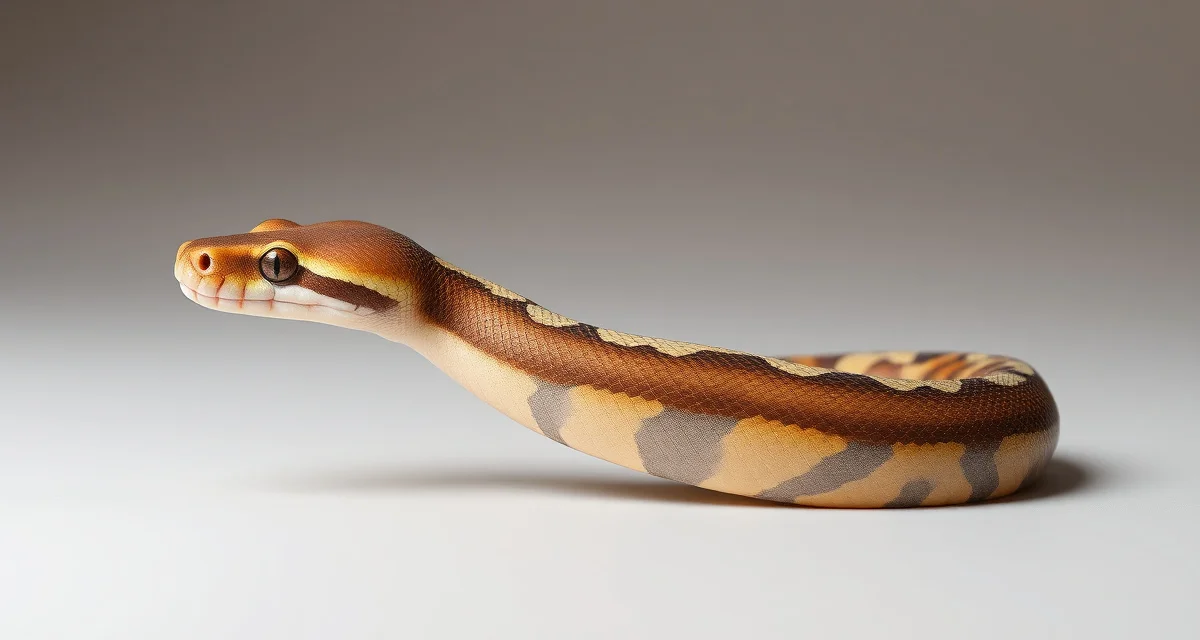
Lesser Ball Python: Genetics, Breeding Outcomes and Pricing
The Lesser is one of the most versatile co-dominant morphs in ball python breeding, not because of its standalone visual (which is subtle), but because of its position in the BEL (Blue-Eyed Lucy) complex and its stacking properties with other genes. Understanding Lesser's allelic relationships is essential before you add it to a project.
TL;DR
- The Lesser morph is a documented genetic variant in ball pythons with established inheritance pattern and pricing history.
- Co-dominant morphs express visually in single copy and produce a distinct super form in double copy (with exceptions like Spider where the super is non-viable).
- Recessive morphs require two copies to be visually expressed; single-copy carriers (hets) look identical to normal ball pythons.
- Documented het claims backed by parentage records are worth significantly more at resale than unverified possible-het claims.
- Market prices for any given morph are heavily influenced by production volume, demand trends, and whether the morph stacks well with high-value genes.
Lesser Genetics
Lesser is co-dominant. Single-copy animals show reduced pattern, slightly yellow/golden coloration, lighter color overall, and often a distinctive pale color with reduced black borders compared to normals.
The super form of Lesser is the Blue-Eyed Lucy (BEL), a fully white animal with blue eyes. But here's the critical detail: Lesser's super form isn't produced by breeding Lesser × Lesser. It's produced by breeding Lesser with any of its allelic partners.
The BEL Complex: Allelic Relationships
Lesser, Butter, Russo (HGW), Phantom, Mystic, and Mocha all occupy the same genetic locus, they're allelic. Two copies of any combination within this complex produces a BEL animal.
BEL-producing pairings (all produce white/blue-eyed animals):
- Lesser × Lesser = BEL
- Lesser × Butter = BEL
- Lesser × Mojave = BEL
- Mojave × Mojave = BEL
- Lesser × Russo = BEL
- Butter × Butter = BEL
The visual appearance of BEL animals can vary slightly depending on which alleles are combined, some have more bluish tones, some are pure white, some have faint pattern visible, but all are white-bodied with blue eyes.
From Lesser × normal:
- 50% Lesser
- 50% normal
From Lesser × Butter:
- 25% BEL (Lesser/Butter compound)
- 25% Lesser
- 25% Butter
- 25% normal
From Lesser × Lesser:
- 25% BEL (Lesser homozygous)
- 50% Lesser
- 25% normal
Mojave and the BEL Complex
Mojave is allelic with Lesser, meaning an animal can carry one copy of Lesser and one copy of Mojave (often called Lesser/Mojave or a "BEL gene combo") which produces a BEL animal. This is why when you breed Lesser × Mojave, you can get BELs in the offspring even though neither parent is "super."
An animal can't carry two full copies of different allelic genes independently. So you won't find an animal that's both "Lesser" and "Mojave" expressed independently, they occupy the same locus.
Visual Identification
Single-copy Lessers are often underwhelming visually on their own, they show reduced patterning, lighter coloration, and a distinctive color that's hard to describe precisely as it varies between animals. The value of Lesser is in its combinations, not its standalone appearance.
BEL animals produced from Lesser combinations are usually pure white with striking blue eyes. The eyes are the defining feature, clear blue, not pink (which would indicate albinism).
Lesser in Combos
Lesser Clown: Pattern disruption from Clown enhanced by Lesser's lightening effect.
Lesser Pied: BEL-complex lightening in the patterned sections of a pied animal.
Lesser Pastel: Brighter, cleaner lesser with Pastel enhancement.
Butter Bee (Butter Pastel Spider): One of the popular BEL-complex combos.
Super Fly (Pastel Pinstripe Lesser): Classic triple combo.
Pricing
| Animal | Typical Market Price |
|---|---|
| Lesser (male) | $75-$150 |
| Lesser (female) | $150-$300 |
| BEL Lesser (male) | $200-$400 |
| BEL Lesser (female) | $400-$800 |
| Lesser Clown (male) | $500-$900 |
| Lesser Clown (female) | $1,200-$2,500 |
Breeding Considerations
The most important thing when working with BEL complex morphs is tracking which allele your animals carry. An animal listed as "BEL" could be Lesser/Lesser, Lesser/Butter, Mojave/Mojave, Lesser/Mojave, etc. The specific allele combination determines what offspring a BEL animal can produce.
A BEL animal that's Lesser/Mojave paired to a normal produces some Lessers, some Mojaves, and some normals, but no other BELs unless the normal happens to carry a BEL allele. A BEL animal that's Lesser/Lesser paired to a normal produces all Lessers (50%) and normals (50%).
Documenting the specific allele makeup of every BEL animal in your collection is essential for planning pairings accurately.
FAQ
What is the best approach to lesser ball python morph?
Lesser is best used as a BEL-complex builder rather than a standalone breeding focus. Its primary value is producing BEL animals when combined with allelic partners (Butter, Mojave, Russo, Phantom, Mystic) or as a lightening/reducing agent stacked with other morphs. Always track and document the specific allele makeup of your Lesser and BEL animals, this affects all downstream pairing calculations.
How do professional breeders handle lesser ball python morph?
Professional Lesser breeders maintain clear documentation of allele combinations in every BEL animal. They use Lesser strategically in triple and quadruple combos where the BEL complex contributes lightening and the blue-eye possibility. They're careful not to mix BEL-complex alleles accidentally in breeding pairs without intent.
What software helps manage lesser ball python morph?
HatchLedger is purpose-built for reptile breeders, connecting animal records, breeding history, clutch outcomes, and financial tracking in one connected system. Unlike general spreadsheets or notes apps, it's designed around the specific workflow of an active breeding season -- from pairing records through hatchling inventory and sales documentation. Free for up to 20 animals.
Sources
- USARK (United States Association of Reptile Keepers)
- World of Ball Pythons (WoBP genetics reference database)
- Association of Reptilian and Amphibian Veterinarians (ARAV)
- MorphMarket (reptile industry marketplace data)
- Ball Python community genetics documentation
Get Started with HatchLedger
Tracking Lesser genetics through multiple generations requires connected records that link parent morphs, clutch outcomes, and het status for every animal in your collection. HatchLedger's genetics engine handles this automatically, making buyer documentation accurate and complete. Try it free with up to 20 animals.