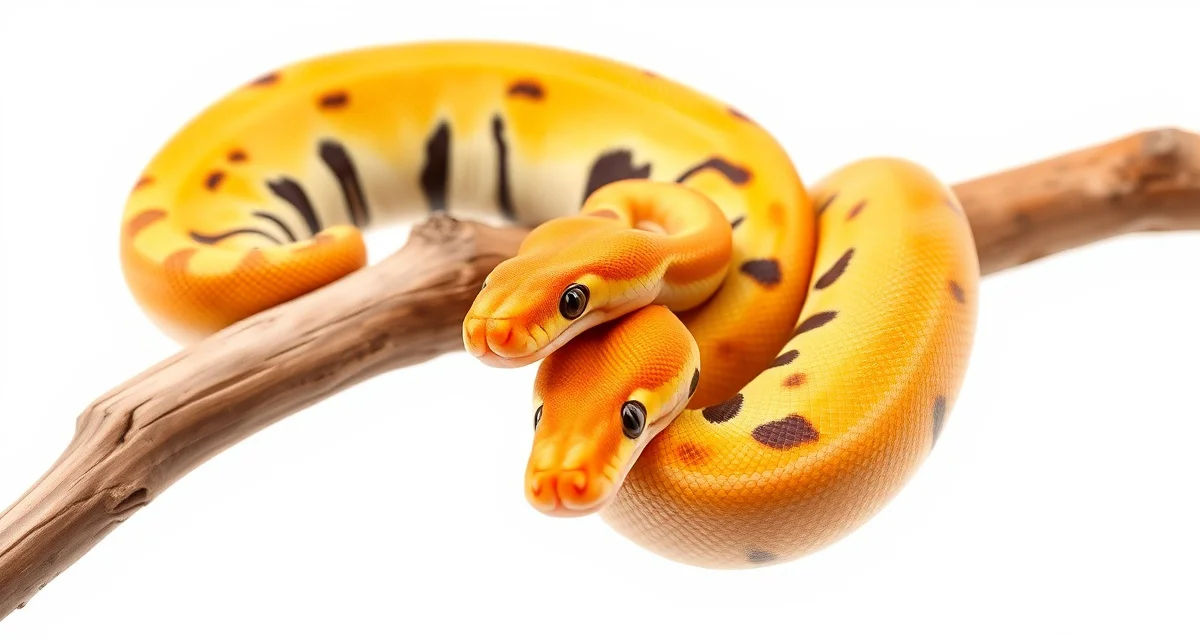
Banana Ball Python: Genetics, Breeding Outcomes and Pricing
By HatchLedger Editorial Team · Published 2025-06-19 · Updated Mar 13, 2026
Banana, also called Coral Glow depending on the line, has been one of the most commercially successful ball python morphs of the last decade. The orange and yellow coloration with black "freckle" spots is instantly recognizable and has broad buyer appeal across collector and pet market segments. It's also genetically interesting: Banana has a sex-linked inheritance quirk that every breeder working with this morph needs to understand.
TL;DR
- The Banana morph is a documented genetic variant in ball pythons with established inheritance pattern and pricing history.
- Co-dominant morphs express visually in single copy and produce a distinct super form in double copy (with exceptions like Spider where the super is non-viable).
- Recessive morphs require two copies to be visually expressed; single-copy carriers (hets) look identical to normal ball pythons.
- Documented het claims backed by parentage records are worth significantly more at resale than unverified possible-het claims.
- Market prices for any given morph are heavily influenced by production volume, demand trends, and whether the morph stacks well with high-value genes.
Banana Genetics
Banana is co-dominant with a unique characteristic: the sex of the breeding male affects which sex offspring express the morph at higher rates.
The Banana male sex-skew:
- A Banana male bred to a normal female produces more Banana females than males (roughly 2:1 female:male among Banana offspring)
- A Banana female bred to a normal male produces more Banana males than females (roughly 2:1 male:female among Banana offspring)
This isn't a strict rule, it's a statistical skew related to the gene's partial sex-linkage on the sex chromosomes. The ratios aren't perfectly predictable per clutch, but over multiple clutches the pattern holds.
Practical implications:
- Breeding a Banana male to normals gives you more Banana females, which are more valuable as production animals
- Breeding a Banana female to normal males gives you more Banana males, which are useful as combo builders
From Banana × normal (standard outcomes):
- ~50% Banana
- ~50% normal
(Sex ratio of Banana offspring skewed as above)
Super Banana: Banana × Banana produces Super Bananas, animals with even more intense orange/yellow, extremely heavy freckling, and a characteristic "alien" look. Super Bananas are visually distinct and valuable.
Banana vs. Coral Glow
Banana (from the VPI line) and Coral Glow (from the NERD line) are the same genetic mutation from two separate discoveries. They're allelic, a Banana/Coral Glow compound animal (bred from one parent of each line) produces Super Banana/Coral Glow effects rather than a different compound expression. In practice, most breeders treat them as the same morph.
Visual Identification
Banana hatchlings are identifiable at hatch by the orange-yellow base coloration with reduced pattern and characteristic black speckling (freckles). The freckles often increase with age and are a hallmark of the morph.
Super Bananas are significantly brighter with extremely heavy freckling. The super form is viable and healthy, a legitimate breeding goal.
Combo Production
Banana is a powerful combo builder. Its orange/yellow tones enhance and interact with other color genes distinctively.
Banana Pastel: Brighter, more uniform yellow-orange. Very popular.
Banana Clown: Orange clown pattern. High market value. One of the most desirable Banana combos.
Banana Pied: Orange-toned pattern on white background. Excellent buyer demand.
Banana Spider: Strong visual impact; remember to disclose Spider wobble.
Banana Enchi: Rich, saturated coloration.
Banana GHi: Dark, high-contrast combination with orange tones.
Banana Pricing
Banana prices have come down significantly from early years due to high production volume, but remain solid for quality animals and combos.
| Animal | Typical Market Price |
|---|---|
| Banana (male) | $80-$150 |
| Banana (female) | $150-$300 |
| Super Banana | $300-$700 |
| Banana Pastel (male) | $150-$300 |
| Banana Pastel (female) | $300-$600 |
| Banana Clown (male) | $600-$1,200 |
| Banana Clown (female) | $1,500-$4,000 |
| Banana Pied (male) | $500-$1,000 |
Breeding Considerations
When running a Banana project, the sex-skew matters for project planning:
- If you want to build a female-heavy Banana breeding base, use Banana males
- If you want more Banana males (as combo producers), use Banana females
This doesn't mean you're guaranteed ratios per clutch, you can get equal sex ratios or even the opposite skew in any individual clutch. But over the life of a project, the statistical pattern is real.
Also track freckle development. Animals with heavy, well-distributed freckles are generally considered higher quality and can command premiums. Some buyers specifically seek heavy-freckle Bananas as pets.
Related Articles
- Bamboo Ball Python: Genetics, Breeding Outcomes and Pricing
- Black Pastel Ball Python: Genetics, Breeding Outcomes and Pricing
- Bumble Bee Ball Python: Genetics, Breeding Outcomes and Pricing
- Butter Ball Python: Genetics, Breeding Outcomes and Pricing
FAQ
What is the best approach to banana ball python morph?
Use Banana males if your goal is building up female Banana breeding stock (the sex-skew produces more Banana females). Focus combo production on high-demand recessive combinations, Banana Clown and Banana Pied represent the top of the market. Track freckle intensity in your animals as a quality indicator; heavy-freckle animals sell at premiums.
How do professional breeders handle banana ball python morph?
Professional Banana breeders understand and plan around the sex-skew in their project strategy. They maintain Super Banana animals as visual anchors for breeding, pair with high-value recessives for premium combo production, and document freckle progression notes in their animal records since buyers often ask about this.
What software helps manage banana ball python morph?
HatchLedger is purpose-built for reptile breeders, connecting animal records, breeding history, clutch outcomes, and financial tracking in one connected system. Unlike general spreadsheets or notes apps, it's designed around the specific workflow of an active breeding season -- from pairing records through hatchling inventory and sales documentation. Free for up to 20 animals.
What is Banana Ball Python: Genetics, Breeding Outcomes and Pricing?
The Banana ball python is a co-dominant morph known for its striking orange and yellow coloration with distinctive black freckle spots. Also sold under the name Coral Glow depending on the breeder line, it carries a unique sex-linked inheritance quirk: the sex of the breeding male influences which offspring express the morph. It has become one of the most commercially successful ball python morphs of the past decade, with strong appeal in both collector and pet markets.
How much does Banana Ball Python: Genetics, Breeding Outcomes and Pricing cost?
Banana ball python pricing varies widely based on genetic combination, lineage documentation, and market demand. Single-gene Bananas typically sell for $100–$300, while combo morphs pairing Banana with high-value genes like Clown or Pied can reach $500–$2,000+. Documented het parentage records meaningfully increase resale value compared to unverified possible-het claims. As production volume has grown over the years, base Banana prices have trended downward while rare combos hold stronger value.
How does Banana Ball Python: Genetics, Breeding Outcomes and Pricing work?
Banana is a co-dominant morph, meaning a single copy produces visible expression and two copies produce a distinct super form. Its notable quirk is sex-linked inheritance: male Bananas statistically produce more female Banana offspring, while female Bananas produce more males. Breeders working with this morph need to account for this when projecting clutch outcomes and planning pairings, especially when trying to produce specific sex ratios in combination morphs.
What are the benefits of Banana Ball Python: Genetics, Breeding Outcomes and Pricing?
Banana offers breeders several practical advantages. Its co-dominant nature means visual offspring appear in roughly half of any pairing, providing reliable production rates. The morph stacks well with a wide range of other genes, making it a versatile building block for high-value combo animals. Its broad visual appeal drives consistent buyer demand across both casual pet owners and serious collectors, helping breeders move inventory efficiently at multiple price points.
Who needs Banana Ball Python: Genetics, Breeding Outcomes and Pricing?
Banana ball pythons are relevant to several audiences: beginner breeders appreciate the predictable co-dominant inheritance and accessible entry pricing; experienced breeders use Banana as a foundation gene for building premium combo morphs; collectors seek specific proven lines or rare pairings; and pet buyers are drawn to the morph's vibrant coloration. Anyone working with ball python genetics, from hobbyist to commercial producer, will encounter Banana given its prevalence in the current market.
Sources
- USARK (United States Association of Reptile Keepers)
- World of Ball Pythons (WoBP genetics reference database)
- Association of Reptilian and Amphibian Veterinarians (ARAV)
- MorphMarket (reptile industry marketplace data)
- Ball Python community genetics documentation
Get Started with HatchLedger
Tracking Banana genetics through multiple generations requires connected records that link parent morphs, clutch outcomes, and het status for every animal in your collection. HatchLedger's genetics engine handles this automatically, making buyer documentation accurate and complete. Try it free with up to 20 animals.