Kingsnake Breeder Setup and Housing: Complete Breeder Guide
Kingsnake breeder setup and housing requires extra attention to separation and security compared to most other colubrid species. Every design decision in a kingsnake room must account for the fact that these animals will eat each other if given the opportunity. Beyond that critical consideration, the fundamental housing approach, rack systems for efficiency at scale, appropriate thermal gradients, and organized record-keeping, is similar to other North American colubrid programs. Breeders using integrated software report 30% less time on administrative tasks, and a well-designed room setup reduces daily care friction while maintaining the safety standards this species demands.
TL;DR
- Kingsnakes and milksnakes span the genus Lampropeltis, with numerous species and subspecies each having distinct cycling requirements.
- Most kingsnake species require 90-120 days of brumation at 45-55 degrees Fahrenheit for consistent breeding.
- Clutch size datas average 8-20 eggs depending on species, with California kingsnakes commonly producing 6-12 eggs.
- Incubation runs 55-75 days at 78-82 degrees Fahrenheit, similar to corn snakes.
- Kingsnake morph genetics overview include albino, anerythristic, and hypo lines plus combination morphs with active development in California kingsnakes, gray-banded kingsnakes, and Mexican black kingsnakes.
The Separation Imperative
Every kingsnake in your collection needs its own fully secure enclosure. There should be no shared housing, no temporary cohabitation, and no "just for tonight" exceptions. Kingsnakes are opportunistic predators that will attack and eat enclosure-mates without behavioral warning. This is not aggression in the mammalian sense; it's simply feeding behavior triggered by proximity and scent.
Design your room so:
- Enclosures are individual and fully secure with locked or clip-sealed lids
- Escapes are impossible; check all enclosures daily for compromised seals
- Adjacent enclosures don't allow physical contact if one animal were to escape
A single escape event in a room of kingsnakes can result in multiple casualties. This is the most important design consideration in any kingsnake facility.
Rack Systems
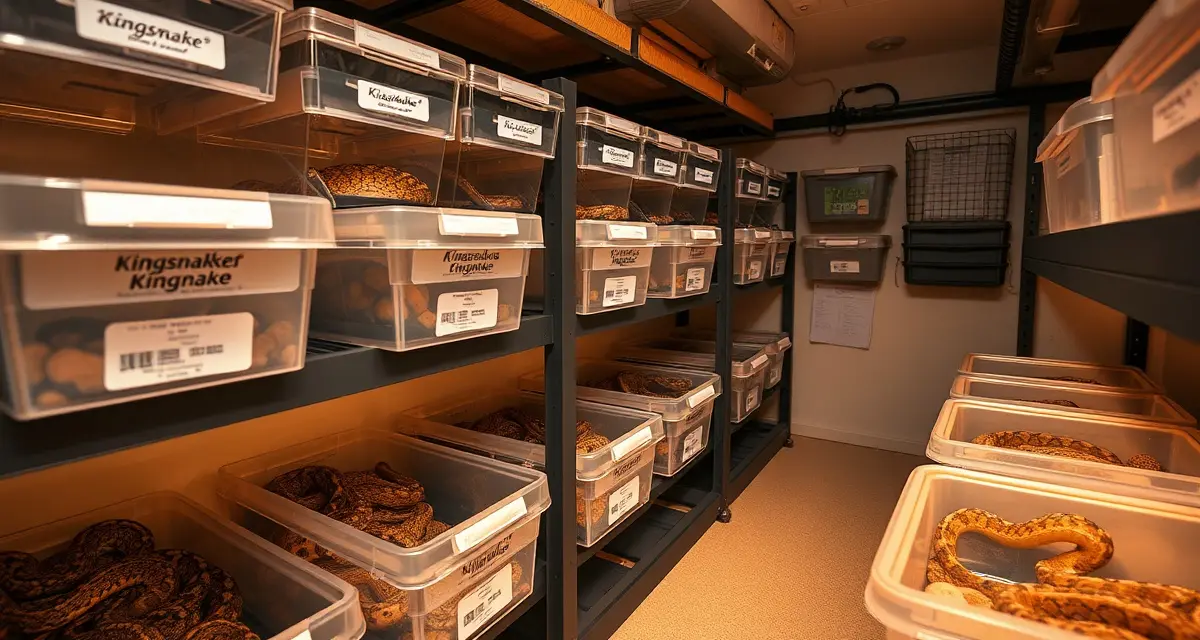
PVC rack systems are the practical choice for collections of 10 or more kingsnakes. They provide individual tubs at stacked positions, space efficiency, and shared heating infrastructure.
Choose tub sizes appropriate to your animals: 6-quart for hatchlings, 16 to 28-quart for juveniles, 41-quart or larger for adult breeders. Tubs in a rack should lock or clip securely in position with no possibility of accidental opening.
Heat tape or rope runs under the back third of each row, connected to individual thermostats per row. Verify temperature inside each tub with a probe at floor level.
seasonal cycling protocol Space
A dedicated cooling area with controlled temperatures in the 55-65°F range is required for seasonal breeding preparation. This could be a basement room, a temperature-controlled spare room, or a purpose-built cooling cabinet.
The cooling space should have its own thermostats and temperature logging. Verify temperatures before moving animals. Log cooling start and end dates in your animal records in HatchLedger's reptile breeder hub.
Feeding Safety in Room Design
The room design should support safe feeding practices:
- Work surface for prey preparation away from enclosure areas
- Hand washing station accessible before and after handling animals
- Feeding hooks or tongs stored visibly and accessibly near feeding areas
- Protocol posted reminding all users to close each enclosure before moving to the next
These aren't decorative; they prevent the accidents that happen when routine deviates from protocol.
Labeling and Record Integration
Label every enclosure with the animal's ID. Match physical labels to your digital records in reptile breeder software comparison-recommended software. Update housing assignments in your records whenever animals move. A mismatch between physical labels and digital records causes feeding and medication errors that can be serious in a collection of valuable breeding animals.
Frequently Asked Questions
What is the best approach to kingsnake breeder setup and housing?
Design for absolute separation first. Every kingsnake gets its own secure enclosure with no exceptions. Use rack systems for efficiency once your collection exceeds 10 animals, with locked or clipped tubs on quality thermostats. Maintain a separate cooling space for seasonal cycling. Post feeding protocols and keep feeding tools accessible. Label everything consistently and connect physical labels to digital records. The safety-first design philosophy saves you from accidents that are otherwise just a matter of time in a kingsnake collection.
How do professional breeders handle kingsnake breeder setup and housing?
Professional kingsnake breeders design their facilities with separation and security as the primary criteria. They use rack systems with secure tub hardware, check every enclosure seal during daily feeding, and maintain written feeding protocols that all personnel follow. Their cooling and incubation spaces are purpose-designed, and their quarantine area is completely separate from the main collection. They maintain digital records that connect every animal to its housing location so record and physical organization are always in sync.
What software helps manage kingsnake breeder setup and housing?
HatchLedger manages multi-species collections with distinct cooling protocols, morph genetics, and clutch records in one system. For kingsnake breeders working across subspecies or multiple species, keeping each animal's protocol and lineage clearly organized prevents the documentation errors that affect buyer trust. Free for up to 20 animals.
Do all kingsnake species need the same cooling duration?
No. California kingsnakes from warmer coastal localities may respond to 90 days of cooling at 50-55 degrees Fahrenheit, while gray-banded kingsnakes from higher elevation Texas habitats may benefit from 120 days at lower temperatures. Eastern kingsnakes from northern localities often need the most aggressive cooling. Research the specific ecology of your animals' locale or subspecies.
Can different kingsnake species be housed together?
Kingsnakes are ophiophagous (snake-eating) and should never be cohabited, including with animals of the same species. Even animals cohabited without incident for extended periods can result in cannibalism. This applies to breeding introductions as well: supervise all introductions and separate animals immediately after copulation.
Sources
- USARK (United States Association of Reptile Keepers)
- Association of Reptilian and Amphibian Veterinarians (ARAV)
- California Academy of Sciences Herpetology Collection
- Herpetologica (Herpetologists League)
- Reptiles Magazine (Bowtie Inc.)
Get Started with HatchLedger
Managing multiple kingsnake species and subspecies with distinct cooling requirements and active morph programs benefits from a system that keeps each animal's protocol, lineage, and clutch history clearly organized. HatchLedger connects all of that data across your collection. Free for up to 20 animals.