Hognose Snake Breeder Setup and Housing: Complete Breeder Guide
Hognose snake breeder setup and housing requires planning that accounts for the species' specific biology while staying practical for a production-scale operation. Western hognose snakes (Heterodon nasicus) are burrowing animals from open grassland habitats, relatively small, and dimorphic in size between males and females. A breeding setup that accounts for these characteristics produces better animal welfare outcomes and simplifies daily management. Breeders using integrated software report 30% less time on administrative tasks, which matters when your physical setup scales and your management time needs to scale efficiently with it.
TL;DR
- Western hognose snakes (Heterodon nasicus) require 60-90 days of seasonal cycling at 50-60 degrees Fahrenheit for reliable breeding success.
- Females that skip cooling often fail to ovulate or produce infertile clutches, making brumation near-mandatory rather than optional.
- Clutch sizes average 8-18 eggs, with adult females commonly producing two clutches per season when managed well.
- Incubation runs 55-65 days at 82-84 degrees Fahrenheit with moderate humidity around 80-85%.
- Western hognose morphs include albino, axanthic, toffee, coral, and several combination lines with active development continuing.
Rack System Design for Western Hognose
Why Racks Make Sense at Breeding Scale
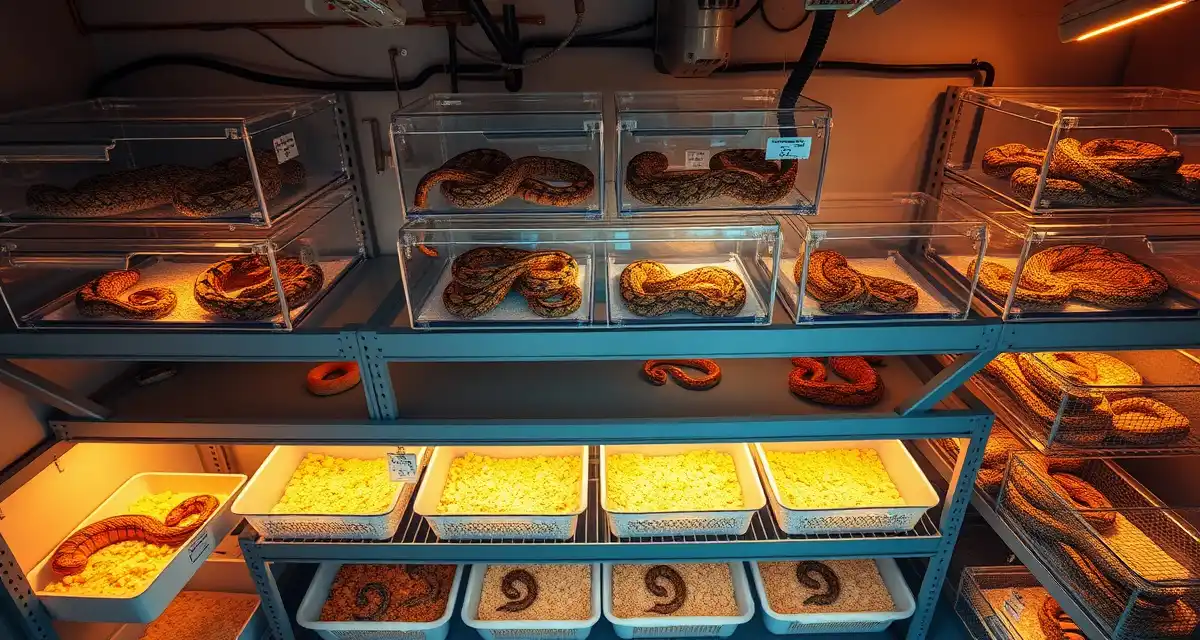
Individual glass terrariums are practical for a hobbyist keeping a few animals, but they don't scale economically or practically to a breeding operation. Rack systems allow you to house many animals individually in a compact footprint, maintain consistent temperatures across the collection, and access each animal quickly for feeding and maintenance.
Western hognose snakes adapt well to rack housing. They're naturally inclined to retreat into cover and don't require height or complex environmental enrichment in their primary housing. A well-designed tub with appropriate substrate, a hide, and a water bowl provides appropriate conditions in a space-efficient format.
Tub Sizing
Adult females: Female western hognose snakes typically reach 24 to 36 inches and may weigh 100 to 250 grams or more. 25 to 32-quart tubs are appropriate for most adult females. Tubs should allow the snake to fully extend and move without crowding.
Adult males: Male western hognose snakes are significantly smaller, typically 14 to 24 inches and 50 to 100 grams. 6 to 15-quart tubs work well for most adult males.
Hatchlings: 6-quart tubs are appropriate from hatch through the first few months. Individual housing from day one.
Rack Models
Multiple manufacturers produce rack systems appropriate for western hognose programs. Ball python racks are often too large and too warm for western hognose housing. Seek racks designed for North American colubrids or configure custom setups.
Heat is typically delivered via heat tape or heat pads running along the bottom of each tub position on the rack. A quality thermostat with a probe at animal level maintains consistent temperature.
Cooling Space
A cooling space is not optional for a serious western hognose breeding program. Females that aren't cooled properly often fail to ovulate, making brumation a near-essential requirement for consistent production.
Your cooling space needs to reliably maintain temperatures of 50 to 60°F for 60 to 90 days. Options include:
Dedicated room: A spare room, garage, or basement that reaches and stays at appropriate temperatures in winter. Verify with a calibrated thermometer, not by assumption.
Wine cooler or modified refrigerator: These can be set to maintain temperatures in the 50 to 60°F range and work well for smaller collections.
Wine cellar: Any climate-controlled space that consistently reaches appropriate temperatures without going below 45°F.
Plan your cooling space before your first breeding season. Animals need to begin cooling in November or December for a late January to February warm-up.
Log cooling start and end dates in HatchLedger's reptile breeder hub. These dates connect to breeding outcomes recorded later in the season, giving you the data to assess whether your cooling protocol is producing optimal results.
Incubation Area
Your incubation setup should be separate from your main animal room with its own climate control. An incubator capable of maintaining 84 to 86°F consistently is necessary; digital incubators with thermostats designed for reptile eggs are the most reliable option.
Verify incubator temperature at egg level with a secondary thermometer. Incubator displays can be off by several degrees, and western hognose eggs benefit from temperatures slightly warmer than many other colubrid species.
Plan incubation container storage. Even a modest western hognose program can generate multiple simultaneous clutches, each requiring individual container labeling and regular monitoring.
Hatchling Area
Hatchling management is particularly demanding in western hognose programs due to the feeding escalation requirements. Plan for:
Individual housing from hatch day: Small racks or tubs dedicated to hatchlings, organized by clutch.
Feeding station space: A clean surface where you can offer prey to individual hatchlings with tongs and observe their response without disturbing others.
Scenting supplies storage: Toads or frogs for scenting purposes, fish products, and other scenting materials should be accessible and organized.
Paper bag supplies: Small paper bags for the enclosure feeding technique that often works for persistent western hognose hatchling refusers.
Reptile breeder software comparison tools that help you track which hatchlings are in which housing positions, and log their individual feeding attempts, make hatchling area management practical at scale.
Substrate and Supply Storage
Maintain a consistent supply of aspen shaving, appropriate incubation substrate (vermiculite or perlite), and appropriately-sized frozen-thawed prey. Western hognose programs require both pinky-sized prey for hatchlings and larger prey for adult breeders.
Dedicated storage space for supplies close to your rack systems reduces time spent on routine maintenance.
Frequently Asked Questions
What is the best approach to hognose snake breeder setup and housing?
Use individual rack housing with appropriately sized tubs for adults and hatchlings. Plan your cooling space before your first breeding season; it's a near-requirement for reliable western hognose production. Set up a dedicated incubation area with a verified-temperature incubator. Build a hatchling area with space for individual feeding management and scenting supplies. Size everything for your target production volume, not your current animal count, so you're not rebuilding your setup every year.
How do professional breeders handle hognose snake breeder setup and housing?
Professional western hognose breeders design their space for both animal welfare and operational efficiency. Their rack systems allow individual housing at scale without excessive labor for daily maintenance. Their cooling space is set up and verified before breeding season begins. Their incubation areas have backup temperature monitoring. Their hatchling setups account for the demanding individual feeding management that western hognose programs require. Every aspect of their physical setup reduces friction in daily management.
What software helps manage hognose snake breeder setup and housing?
HatchLedger logs cooling start and end dates, temperature records, post-cooling feeding resumption, and all pairing sessions for each hognose breeding animal. These records connect to clutch outcomes when females lay, allowing you to compare your seasonal protocol to breeding results across multiple seasons. Free for up to 20 animals.
Can western hognose snakes double-clutch?
Yes, double-clutching is common and reliable in well-conditioned western hognose females. The first clutch is typically laid in April or May, and if the female feeds aggressively through June, a second clutch often follows in July or August. Tracking body condition through the season tells you whether a female is ready for a second clutch.
Why do some hognose females play dead during introductions?
Death-feigning (thanatosis) is a well-known hognose defensive behavior and can occur during breeding introductions. Most females habituate to handling over time and reduce this response. Experienced males are generally persistent through the female's initial responses. Keeping introduction sessions calm and minimally disturbing helps.
Sources
- USARK (United States Association of Reptile Keepers)
- Association of Reptilian and Amphibian Veterinarians (ARAV)
- Society for the Study of Amphibians and Reptiles (SSAR)
- Herpetological Review
- Great Plains Wildlife Management
Get Started with HatchLedger
Western hognose breeding with multiple morphs and double-clutching females benefits from connected records that link cooling dates, pairing introductions, and per-clutch outcomes. HatchLedger tracks all of it and lets you compare seasonal protocols against results over multiple years. Free for up to 20 animals.