Corn Snake Breeder Setup and Housing: Complete Breeder Guide
By HatchLedger Editorial Team · Published 2025-05-26 · Updated Mar 13, 2026
Corn snake breeder setup and housing decisions affect every aspect of your program from animal health to daily care efficiency to the quality of your records. Getting your physical setup right before scaling your collection saves time and money compared to retrofitting a poorly designed space later. Breeders using integrated software report 30% less time on administrative tasks, and a well-designed physical setup contributes to that efficiency by reducing friction in daily routines.
TL;DR
- Corn snakes (Pantherophis guttatus) are the most widely bred colubrid in captivity, with hundreds of documented morphs spanning all three major inheritance patterns.
- Seasonal cycling of 60-90 days at 50-60 degrees Fahrenheit is the standard cycling protocol for reliable spring breeding.
- Clutch sizes average 12-24 eggs for adult females, with experienced breeders often producing 2 clutches per season from well-conditioned females.
- Incubation setup runs 55-65 days at 78-82 degrees Fahrenheit, cooler than most python species.
- Corn snake morph genetics include multiple allelic series, including the amelanistic and anerythristic pathways, that interact in non-obvious ways.
Rack Systems vs. Individual Enclosures
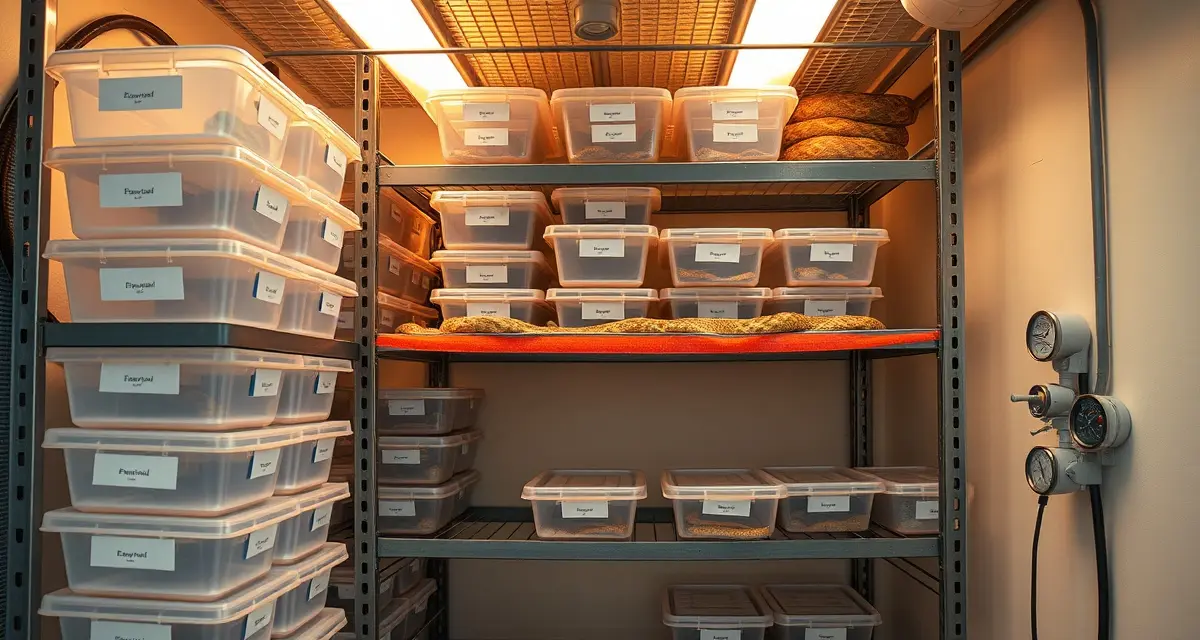
Most corn snake breeders managing collections of 10 or more animals use rack systems. Racks stack multiple tubs in a compact footprint, share heat from heat tape or rope, and dramatically reduce the space and cost compared to individual enclosures for the same animal count.
Rack advantages:
- Space efficiency for large collections
- Lower cost per animal slot
- Consistent temperatures across multiple animals sharing a heat source
- Easy to scale as the collection grows
Individual enclosure advantages:
- Better for display or show collections
- Allows more complex setups (larger hides, more substrate depth)
- Easier to observe individual animals
- Preferable for breeding pairs you want to monitor closely during behavioral cycling
Many breeders use racks for hatchling and juvenile animals and individual display enclosures for their primary adult breeders.
Tub Selection for Rack Systems
Choose tubs sized appropriately for animal size. A good rule of thumb: the snake should be able to fully extend in one dimension of the tub. Common tub sizes used in corn snake racks:
- 6-quart tubs for hatchlings (3 to 6 months)
- 16 to 28-quart tubs for juveniles
- 41-quart or larger for adult breeding animals
Tubs should be opaque or semi-opaque to reduce visual stress. Drill ventilation holes in the sides and lid, keeping openings small enough that the snake can't push through or get stuck.
Heating Systems for Corn Snake Racks
Heat tape or heat rope installed under each row of a rack provides belly heat along the back third of the tub floor. This mimics the warm surface heat corn snakes use for thermoregulation.
Every heat tape run needs its own quality thermostat with a probe under the tub it's heating. Don't connect multiple tub rows to a single thermostat unless the manufacturer specifically designs for that. Verify temperatures inside each tub with a digital thermometer periodically.
In larger rooms, supplemental ambient heating may be needed during winter months to maintain appropriate rack temperatures without overstressing your individual heat tape thermostats.
Cooling Space
Your breeding program needs dedicated cooling space for the winter cycling period. Options include:
- A basement room or area that naturally maintains 55-65°F in winter
- A spare bedroom with thermostat control
- A purpose-built cooling cabinet or converted wine cooler for smaller collections
The cooling space should be separated from your main collection, have its own thermostat control, and be accessible for the monitoring and occasional feeding checks during the cooling period.
Incubation Area
Dedicate a separate area for incubation with a quality incubator, stable ambient temperatures, and storage for incubation supplies. Incubators should be positioned away from windows, direct sunlight, and drafts that could cause temperature fluctuation.
Label every clutch container clearly and connect the physical labels to your digital clutch size records in HatchLedger's reptile breeder hub. This link between your physical incubation setup and your digital records keeps your clutch data accurate when you're managing multiple clutches simultaneously.
Quarantine Setup
A separate quarantine area is non-negotiable for any breeding program. This doesn't need to be elaborate, but it must be:
- Physically separate from the main collection (ideally a different room)
- Equipped with its own tools, equipment, and supplies
- Accessible with good hand hygiene practices before and after entry
New animals go directly to quarantine and stay there for 60 to 90 days before joining the main collection.
Room Layout and Organization
Label every tub and rack position with the animal's ID. A reference chart matching animal IDs to rack positions, printed and posted in the room, reduces errors during feeding and record-keeping.
When animals move between rack positions or to and from breeding setups, update your records immediately. Stale location data causes feeding errors and record attribution problems. Reptile breeder software comparison resources highlight this as a common operational pain point for breeders who don't log housing changes promptly.
Frequently Asked Questions
What is the best approach to corn snake breeder setup and housing?
Use rack systems for efficiency once your collection exceeds 10 animals. Heat every rack with quality heat tape on individual thermostats, verify temperatures regularly, and label every position clearly. Maintain a dedicated cooling space for winter cycling, a separate incubation area, and a physically separate quarantine space. Plan your room layout before installing racks so drainage, lighting, and traffic flow work efficiently. The physical setup should support your record-keeping system: every enclosure labeled, every position tracked, and every change logged promptly.
How do professional breeders handle corn snake breeder setup and housing?
Professional corn snake breeders design their facilities for efficiency and scalability. They use rack systems to maximize collection density, install thermostats on every heat source, and verify temperatures regularly. They maintain clear physical organization with labeled enclosures and racks matched to their digital records. Their cooling and incubation areas are purpose-designed with appropriate temperature control. Quarantine is always a separate physical space, not just a different rack position in the same room.
What software helps manage corn snake breeder setup and housing?
HatchLedger is purpose-built for reptile breeders, connecting animal records, breeding history, clutch outcomes, and financial tracking in one system. Unlike generic spreadsheets, it's designed around the specific workflow of an active breeding season. Free for up to 20 animals.
Can corn snakes produce two clutches in a single breeding season?
Yes, many adult corn snake females will double-clutch reliably, especially when kept at ideal temperatures and fed aggressively between clutches. Allow females at least 4-6 weeks of heavy feeding between the first and second clutch. Tracking body weight before and after each clutch helps assess whether a female is in condition for a second clutch that season.
What temperature should corn snake eggs be incubated at?
Corn snake eggs incubate best at 78-82 degrees Fahrenheit. Higher temperatures up to 84 degrees accelerate development but reduce the hatch window and can increase developmental problems. Below 75 degrees slows development significantly. Unlike ball python eggs, corn snake eggs tolerate a wider temperature range reasonably well.
What are the most profitable corn snake morphs for breeders?
Multi-gene combination morphs command the highest prices. Motley, Tessera, and Scaleless are structural genes that add significant value to color morph animals. Scaleless corn snakes in particular fetch $300-800 or more depending on color morph combination. Single-gene morphs like Amelanistic and Anerythristic are common and prices are compressed; combinations including structural genes maintain stronger margins.
What is Corn Snake Breeder Setup and Housing: Complete Breeder Guide?
Corn Snake Breeder Setup and Housing: Complete Breeder Guide is a comprehensive resource covering everything needed to establish and run a successful corn snake breeding program. It covers rack systems versus individual enclosures, seasonal cycling protocols, incubation setup, morph genetics, and record-keeping strategies. The guide is designed to help breeders at any level build an efficient, well-organized setup that supports animal health and scales as their collection grows.
How much does Corn Snake Breeder Setup and Housing: Complete Breeder Guide cost?
This guide is free educational content published on HatchLedger. There is no purchase required to access the article. HatchLedger may offer optional paid tools or software for breeding records and program management, but the guide itself is available at no cost to anyone interested in corn snake breeding.
How does Corn Snake Breeder Setup and Housing: Complete Breeder Guide work?
The guide works by walking you through each component of a breeder setup in a logical sequence — physical housing decisions first, then environmental controls, cycling schedules, incubation parameters, and record-keeping systems. Each section builds on the last so you can set up your space correctly from the start rather than retrofitting a poorly designed layout after your collection grows.
What are the benefits of Corn Snake Breeder Setup and Housing: Complete Breeder Guide?
Key benefits include avoiding costly setup mistakes early, reducing daily care time through an efficient physical layout, and producing more consistent breeding results. The guide covers proven cycling protocols — 60–90 days at 50–60°F — and incubation parameters — 78–82°F for 55–65 days — that support reliable clutch production, including the potential for two clutches per season from well-conditioned females.
Who needs Corn Snake Breeder Setup and Housing: Complete Breeder Guide?
This guide is ideal for new corn snake breeders building their first dedicated setup, hobbyists ready to scale beyond a few animals, and intermediate breeders looking to improve efficiency or breeding consistency. It is also useful for anyone transitioning from casual keeping to a structured program managing 10 or more animals across multiple morphs and genetic pairings.
Related Articles
Sources
- USARK (United States Association of Reptile Keepers)
- Association of Reptilian and Amphibian Veterinarians (ARAV)
- Herpetological Review (Society for the Study of Amphibians and Reptiles)
- Reptiles Magazine (Bowtie Inc.)
- Society for the Study of Amphibians and Reptiles (SSAR)
Get Started with HatchLedger
Corn snake breeders managing multiple morphs, double-clutching females, and complex genetic documentation benefit from a system that links animal records to clutch outcomes and keeps morph genetics traceable across generations. HatchLedger handles all of this, free for up to 20 animals.