Burmese Python Incubation Parameters: Complete Breeder Guide
By HatchLedger Editorial Team · Published 2025-05-03 · Updated Mar 13, 2026
Burmese python egg incubation is a technically demanding phase that combines the principles of controlled-environment incubation with the practical challenges of managing very large clutches of large eggs for nearly two months. Getting the parameters right is the difference between a 90% hatch rate and a catastrophic loss. Breeders using integrated software report 30% less time on administrative tasks, which gives you capacity to monitor large incubation setups with the attention they require.
TL;DR
- Burmese pythons (Python bivittatus) are among the largest constrictors in captivity, with breeding females commonly exceeding 100-200 lbs.
- Clutch sizes average 25-50 eggs, making Burmese pythons among the most productive large constrictors in captive breeding.
- Cycling typically involves a 4-8 week period of reduced temperatures (dropping 8-12 degrees Fahrenheit) and reduced feeding frequency.
- Incubation runs 60-65 days at 88-90 degrees Fahrenheit, with females capable of thermoregulating eggs by muscular shivering.
- Compliance requirements requirements for Burmese python ownership and interstate transport vary by state, with federal protections under the Lacey Act applying in some jurisdictions.
A Burmese python clutch of 60-80 eggs needs more incubation space, more careful humidity management, and more attentive monitoring than a ball python clutch of 8 eggs. The scale changes the stakes considerably -- a failed incubation representing a large clutch of morphs is a substantial financial loss in addition to a disappointing breeding season.
Incubator Setup
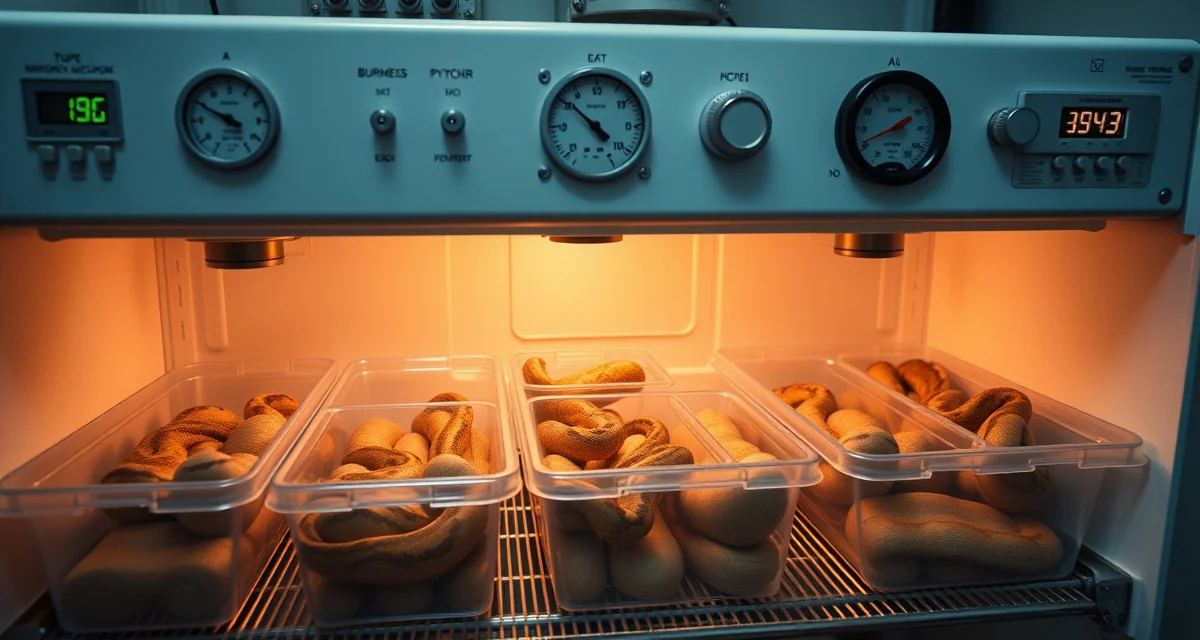
Most Burmese breeders use large commercial incubators or purpose-built incubation cabinets rather than small countertop units. A ProStar, Lyon Technologies, or similar commercial reptile incubator provides more consistent temperature control across a large internal volume than consumer-grade units designed for chickens or small reptile clutches.
Some Burmese breeders allow females to maternally incubate their eggs by coiling around them in a dedicated nesting box. Burmese pythons are excellent maternal incubators -- they generate heat through muscular contractions (shivering thermogenesis) and regulate the clutch temperature remarkably accurately. Maternal incubation can produce excellent hatch rates, but it requires the female to fast for the entire incubation period (approximately 60 days) and imposes significant physical stress. Well-conditioned females handle this well; marginally conditioned females may suffer significant weight loss.
Temperature Parameters
The target incubation temperature for Burmese python eggs is 88-90F (31-32C). This range produces normal development and typical incubation duration of 60-70 days. Temperatures below 85F slow development and increase incubation duration. Temperatures above 92-93F can cause developmental abnormalities and death of embryos.
Temperature consistency is more important than hitting an exact number within the acceptable range. An incubator that holds steady at 88.5F is better than one that fluctuates between 86 and 91F. Use a calibrated probe thermometer inside your incubation container (not just the incubator's built-in display) to verify actual egg-level temperatures.
Humidity Parameters
Humidity management is where most incubation failures originate. Target substrate moisture that keeps eggs at approximately their lay weight throughout incubation. Eggs losing more than 10-15% of their lay weight by mid-incubation are too dry. Eggs gaining significant weight or showing condensation on the surface may be too wet.
Common incubation substrate options include perlite, vermiculite, and sphagnum moss. For large Burmese clutches, perlite is widely used at a 1:1 ratio of perlite to water by weight. This provides moderate moisture retention with good air exchange. Vermiculite holds more moisture and may be appropriate in drier facilities or incubators with higher air exchange rates.
Weigh your eggs on day 1 and track weight at weekly intervals. If eggs are consistently losing weight faster than the 10-15% threshold, add slightly more moisture to your substrate. If they're gaining weight, reduce substrate moisture slightly.
Container Setup and Airflow
Large Burmese clutches are typically incubated in multiple containers rather than a single large tub. Separating a 70-egg clutch across two or three containers reduces the risk that a localized mold problem or humidity issue affects the entire clutch.
Containers need some air exchange. Pure airtight containers accumulate CO2 from developing embryos and can impair development. Many breeders use snap-lid containers with small holes covered with damp packing material, or commercially available egg-incubation containers with built-in ventilation.
Don't open containers more than necessary. Each opening releases humidity and temperature stability. Keep the incubation area at a stable ambient temperature so opening the incubator doesn't cause sharp temperature drops to the eggs.
HatchLedger lets you log incubation start date, temperature data, weight checks, and hatch dates for every clutch, building a complete incubation record for each breeding season.
HatchLedger connects your incubation records to clutch P&L so successful and failed hatch rates feed into your financial tracking.
Frequently Asked Questions
What is the best approach to Burmese python egg incubation parameters?
Incubate at 88-90F with humidity maintained via substrate moisture that keeps eggs near their lay weight. Monitor egg weights weekly and adjust substrate moisture as needed. Use multiple incubation containers for large clutches to limit risk from localized problems. Verify actual egg-level temperature with a calibrated probe rather than relying on incubator displays. Consider maternal incubation for well-conditioned females as an alternative to artificial incubation -- Burmese pythons are effective maternal incubators when in proper condition.
How do professional breeders handle Burmese python egg incubation?
Professional Burmese breeders use high-quality commercial incubators with reliable temperature controllers, verify egg-level temperatures with calibrated probes, and track egg weights from lay through hatch. They separate large clutches across multiple containers to limit risk. They log temperature and humidity data throughout the 60-70 day incubation period and use that data to evaluate whether their setup is performing consistently. When hatch rates are lower than expected, the incubation records help them diagnose whether the problem was temperature instability, humidity issues, or a pre-incubation factor.
What software helps manage Burmese python incubation records?
HatchLedger tracks every animal, clutch, and sale record for Burmese python breeders, with documentation that supports regulatory compliance and buyer confidence. When managing large clutches and compliance requirements simultaneously, a connected system prevents the record-keeping gaps that create problems at sale. Free for up to 20 animals.
Are Burmese pythons legal to own and breed in all US states?
No. Burmese pythons are listed as an injurious species under the Lacey Act, which restricts interstate transport. Several states have additional bans on ownership entirely. Check current state and federal regulations before acquiring or transporting animals. USARK maintains updated resources on applicable regulations.
How large should a Burmese python enclosure be for a breeding pair?
Breeding females typically require enclosures of at least 8x4 feet and often larger for full-grown adults. Dedicated breeding rooms or custom builds are standard at scale. Thermal gradient with hot spots at 88-92 degrees Fahrenheit and ambient temperatures in the mid-70s allows proper thermoregulation.
What is Burmese Python Incubation Parameters: Complete Breeder Guide?
This guide is a comprehensive reference for captive breeders managing Burmese python (Python bivittatus) egg incubation. It covers the full process from pre-lay cycling through hatch, including temperature and humidity targets, clutch size expectations, female brooding behavior, and compliance considerations under the Lacey Act. Given the scale of Burmese python breeding — clutches of 25–50+ eggs requiring nearly two months of careful monitoring — this guide consolidates the critical parameters needed to maximize hatch rates and minimize losses.
How much does Burmese Python Incubation Parameters: Complete Breeder Guide cost?
This is a free educational article published on HatchLedger. There is no purchase required to access the incubation parameter guide. HatchLedger also offers breeding management software that some breeders use alongside reference articles like this one, but reading the guide itself carries no cost. Any optional tools or software mentioned may have their own pricing structures separate from the article content.
How does Burmese Python Incubation Parameters: Complete Breeder Guide work?
The guide walks breeders through each phase of the incubation process: initiating a breeding cycle with a 4–8 week temperature drop of 8–12°F, monitoring egg development over a 60–65 day incubation period at 88–90°F, and managing the unique challenge of large clutches from a large-bodied species. It also addresses female brooding behavior, including muscular shivering thermoregulation, and flags legal compliance issues relevant to Burmese python ownership and transport.
What are the benefits of Burmese Python Incubation Parameters: Complete Breeder Guide?
Following proven incubation parameters for Burmese pythons significantly improves hatch rates — the difference between 90% success and catastrophic clutch loss often comes down to temperature consistency and humidity management. This guide helps breeders avoid common mistakes with large, high-value clutches, understand female brooding biology, and build reliable protocols. Breeders using structured record-keeping alongside guides like this report spending 30% less time on administrative overhead, freeing attention for hands-on clutch monitoring.
Who needs Burmese Python Incubation Parameters: Complete Breeder Guide?
This guide is intended for experienced and intermediate reptile breeders working with Burmese pythons in a captive breeding program. Because Burmese pythons are large constrictors subject to federal Lacey Act regulations and varying state-level restrictions, it is most relevant to breeders already permitted to keep and transport the species. It is also useful for reptile facility managers, herpetological society members, and anyone transitioning from smaller python species to managing the logistical demands of large Burmese clutches.
How long does Burmese Python Incubation Parameters: Complete Breeder Guide take?
Burmese python incubation runs approximately 60–65 days from egg lay to hatch at the recommended temperature range of 88–90°F. Before eggs are laid, breeders should allow 4–8 weeks for the breeding cool-down cycle. In total, from the start of cycling to hatch, the process typically spans 3–4 months. Clutch monitoring is ongoing throughout, and because females can brood eggs via thermoregulatory shivering, breeders must decide early whether to allow natural brooding or move eggs to an incubator.
Related Articles
- Reticulated Python Incubation Parameters: Complete Breeder Guide
- Blood Python Egg Incubation Setup: Complete Breeder Guide
- Boa Constrictor Incubation Parameters: Complete Breeder Guide
Sources
- USARK (United States Association of Reptile Keepers)
- Association of Reptilian and Amphibian Veterinarians (ARAV)
- US Fish and Wildlife Service (Injurious Wildlife regulations)
- Journal of Herpetology (Society for the Study of Amphibians and Reptiles)
- Florida Fish and Wildlife Conservation Commission
Get Started with HatchLedger
Burmese python breeding involves large animals, large clutches, and compliance documentation that is difficult to manage without a dedicated system. HatchLedger tracks every animal, clutch, and sale record in one place, giving you the documentation you need for regulatory compliance and buyer confidence. Try it free with up to 20 animals.