Burmese Python Husbandry for Breeders: Complete Breeder Guide
By HatchLedger Editorial Team · Published 2025-06-20 · Updated Mar 13, 2026
Keeping Burmese pythons in a breeding program is a substantial commitment of space, infrastructure, and resources. These are among the largest captive snakes in the hobby -- adult females routinely reach 12-18 feet and 100-150 pounds. Everything about their care scales up accordingly: enclosures, heating systems, feeding logistics, and the physical demands of routine husbandry. Breeders using integrated software report 30% less time on administrative tasks, which is time you'll need back when daily husbandry for large constrictors is inherently more labor-intensive than smaller species.
TL;DR
- Burmese pythons (Python bivittatus) are among the largest constrictors in captivity, with breeding females commonly exceeding 100-200 lbs.
- Clutch sizes average 25-50 eggs, making Burmese pythons among the most productive large constrictors in captive breeding.
- Cycling typically involves a 4-8 week period of reduced temperatures (dropping 8-12 degrees Fahrenheit) and reduced feeding frequency.
- Incubation parameters runs 60-65 days at 88-90 degrees Fahrenheit, with females capable of thermoregulating eggs by muscular shivering.
- Compliance requirements requirements for Burmese python ownership and interstate transport vary by state, with federal protections under the Lacey Act applying in some jurisdictions.
Burmese python husbandry for breeding differs from single-animal pet care primarily in the rigor of the system you need to maintain. Animals need to stay in breeding condition year-round, seasonal cycling needs to be precise, and your facility needs to handle the scale of production that large clutches generate.
Enclosure Requirements for Adult Breeding Animals
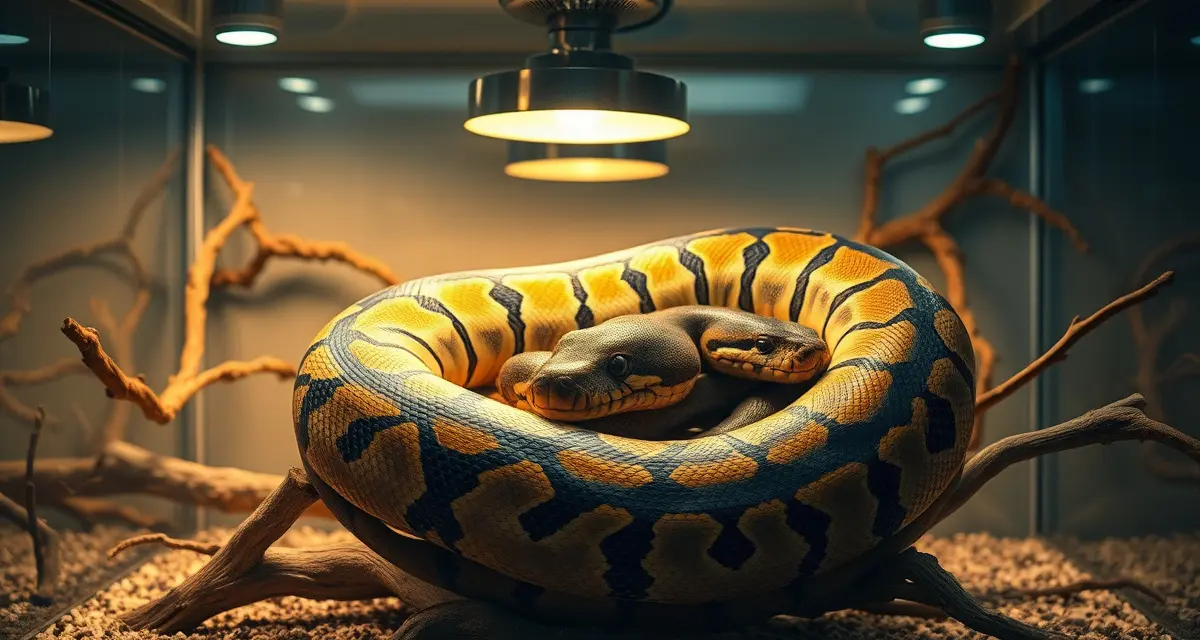
Adult Burmese pythons require very large enclosures. An adult female at 12-14 feet needs a minimum enclosure of 8'x4'x4'. Very large females (16-18 feet) need proportionally more space. Custom-built wooden enclosures with PVC liner or purpose-built large constrictor enclosures are the standard -- commercial enclosures designed for smaller pythons simply aren't available in the sizes needed for large Burmese.
Build enclosures with service access in mind. You need to be able to reach every part of the enclosure for cleaning, and you need to be able to remove the animal safely when necessary. Multiple front-opening doors and top-access panels make a large enclosure much more manageable. Lock latches are strongly recommended -- Burmese pythons are strong enough to push open unsecured doors.
Heating a large Burmese enclosure requires more thought than small snake heating. Under-tank heaters don't work at this scale. Radiant heat panels mounted under a wooden shelf, ceramic heat emitters with thermostats, or deep heat projectors are the standard approaches. Maintain warm-side access at 88-92F with a cool ambient around 76-80F.
Feeding Adult Breeding Animals
Adult Burmese pythons consume large prey items -- rabbits, large rats, or similarly sized prey. The feeding costs for large animals are substantial. A female eating one jumbo rabbit or equivalent every 2-3 weeks represents a significant ongoing expense that should be factored into your per-animal cost calculations.
Frozen/thawed prey is preferable for safety and biosecurity. Live prey items carry risk of injury to the snake and are more difficult to source and handle safely for very large prey. Pre-killed prey (freshly killed before offering) is an acceptable middle ground for animals that are hesitant about F/T.
Adult females should maintain feeding through most of the year except during breeding season cycling when some reduction is normal and expected. Males may fast for extended periods during and after breeding season. Don't force-feed a male that's fasting during or shortly after breeding season unless weight loss becomes significant.
Water and Humidity Management
Burmese pythons need large, sturdy water dishes -- large enough for the animal to soak in. Rubberized stock tubs or large commercial food-grade containers work well for adult animals. Check water daily and replace when soiled. Snakes that are preparing to shed will often soak for extended periods, which is normal.
Humidity in the 60-70% range is appropriate for Burmese pythons. Higher humidity supports shed cycles; lower humidity (below 50%) increases the risk of retained sheds, especially with large animals where a retained shed can cover significant body area. Monitor your actual enclosure humidity rather than estimating.
Safety Protocols
Large Burmese pythons require a two-person safety protocol for enclosure access. Never work alone with a large adult Burmese python -- a snake of this size can be dangerous if it mistakes you for prey or becomes defensive. This is not an exaggeration or overcaution; it's standard practice among experienced large constrictor breeders.
Establish clear safety rules for your facility: who has access, what the handling protocol is, and what to do in an emergency. These rules should be consistent and non-negotiable.
HatchLedger tracks feeding, weight, and health records for each breeding animal, giving you a consistent record of their condition and any behavioral changes that might indicate health issues.
HatchLedger connects husbandry costs to your breeding program's financial records so you know exactly what each breeding animal costs to maintain annually.
Frequently Asked Questions
What is the best approach to Burmese python husbandry for breeders?
Provide appropriately sized enclosures with warm-side access at 88-92F and cool ambient around 76-80F. Feed on a regular schedule using appropriately sized F/T prey. Maintain humidity at 60-70% and provide water dishes large enough for soaking. Follow strict two-person safety protocols for enclosure access with large adults. Monitor body condition consistently -- animals should be in lean-to-moderate condition year-round, not obese. Log all husbandry observations so you have historical data for health and breeding decisions.
How do professional breeders handle Burmese python husbandry at scale?
Professionals build their facilities to handle the physical demands of large constrictor care -- appropriate space, proper infrastructure, and safe handling protocols. They maintain consistent feeding and monitoring schedules rather than ad hoc approaches that lead to missed feedings or overlooked health issues. Safety protocols are non-negotiable and are followed even when it's inconvenient. They also track all husbandry costs per animal so their financial picture reflects reality rather than wishful thinking about what large constrictor breeding costs.
What software helps manage Burmese python husbandry records?
HatchLedger tracks every animal, clutch, and sale record for Burmese python breeders, with documentation that supports regulatory compliance and buyer confidence. When managing large clutches and compliance requirements simultaneously, a connected system prevents the record-keeping gaps that create problems at sale. Free for up to 20 animals.
Are Burmese pythons legal to own and breed in all US states?
No. Burmese pythons are listed as an injurious species under the Lacey Act, which restricts interstate transport. Several states have additional bans on ownership entirely. Check current state and federal regulations before acquiring or transporting animals. USARK maintains updated resources on applicable regulations.
How large should a Burmese python enclosure be for a breeding pair?
Breeding females typically require enclosures of at least 8x4 feet and often larger for full-grown adults. Dedicated breeding rooms or custom builds are standard at scale. Thermal gradient with hot spots at 88-92 degrees Fahrenheit and ambient temperatures in the mid-70s allows proper thermoregulation.
What is Burmese Python Husbandry for Breeders: Complete Breeder Guide?
The Burmese Python Husbandry for Breeders guide on HatchLedger is a comprehensive resource covering everything captive breeders need to know about keeping and breeding Python bivittatus. It addresses enclosure sizing, heating infrastructure, cycling protocols, incubation parameters, clutch management, and compliance considerations for one of the largest constrictors in the hobby — females routinely exceed 100–150 pounds and 12–18 feet.
How much does Burmese Python Husbandry for Breeders: Complete Breeder Guide cost?
The guide itself is free to read on HatchLedger. There is no purchase required to access the husbandry information. Breeders looking to streamline their record-keeping alongside this guide may want to explore HatchLedger's breeding software, which helps manage animals, clutches, and administrative tasks that become significant at the scale Burmese python programs demand.
How does Burmese Python Husbandry for Breeders: Complete Breeder Guide work?
The guide walks breeders through each phase of a Burmese python breeding season: conditioning adults, cycling with reduced temperatures (dropping 8–12°F over 4–8 weeks), introducing pairs, managing gravid females, and incubating clutches at 88–90°F for 60–65 days. It also covers the unique biology of Burmese pythons, including the female's ability to thermoregulate eggs through muscular shivering.
What are the benefits of Burmese Python Husbandry for Breeders: Complete Breeder Guide?
The guide consolidates proven husbandry practices for a species that punishes gaps in knowledge with serious consequences — escapes, injuries, or breeding failures. Breeders gain structured guidance on cycling, incubation, and clutch management for a species that produces 25–50 eggs per clutch. Following consistent protocols reduces costly mistakes and supports the administrative efficiency that large-scale programs require.
Who needs Burmese Python Husbandry for Breeders: Complete Breeder Guide?
This guide is written for serious reptile breeders committed to working with large constrictors at a professional or advanced hobbyist level. It assumes you have the space, infrastructure, and resources to house adult Burmese pythons properly. It is especially relevant for breeders scaling up their programs, adding Burmese pythons to an existing collection, or seeking to standardize their husbandry and compliance practices.
How long does Burmese Python Husbandry for Breeders: Complete Breeder Guide take?
Reading the guide takes under 30 minutes, but implementing a full Burmese python breeding season spans roughly 10–12 months — from pre-season conditioning through cycling, breeding, egg incubation (60–65 days), and hatchling management. Because these are large, long-lived animals, breeders should also account for multi-year timelines before females reach breeding size and productivity.
Related Articles
- Reticulated Python Husbandry for Breeders: Complete Breeder Guide
- Blood Python Record Keeping for Breeders: Complete Breeder Guide
- Boa Constrictor Husbandry for Breeders: Complete Breeder Guide
- Burmese Python Breeder Setup and Housing: Complete Breeder Guide
Sources
- USARK (United States Association of Reptile Keepers)
- Association of Reptilian and Amphibian Veterinarians (ARAV)
- US Fish and Wildlife Service (Injurious Wildlife regulations)
- Journal of Herpetology (Society for the Study of Amphibians and Reptiles)
- Florida Fish and Wildlife Conservation Commission
Get Started with HatchLedger
Burmese python breeding involves large animals, large clutches, and compliance documentation that is difficult to manage without a dedicated system. HatchLedger tracks every animal, clutch, and sale record in one place, giving you the documentation you need for regulatory compliance and buyer confidence. Try it free with up to 20 animals.