Burmese Python Financial Tracking: Complete Breeder Guide
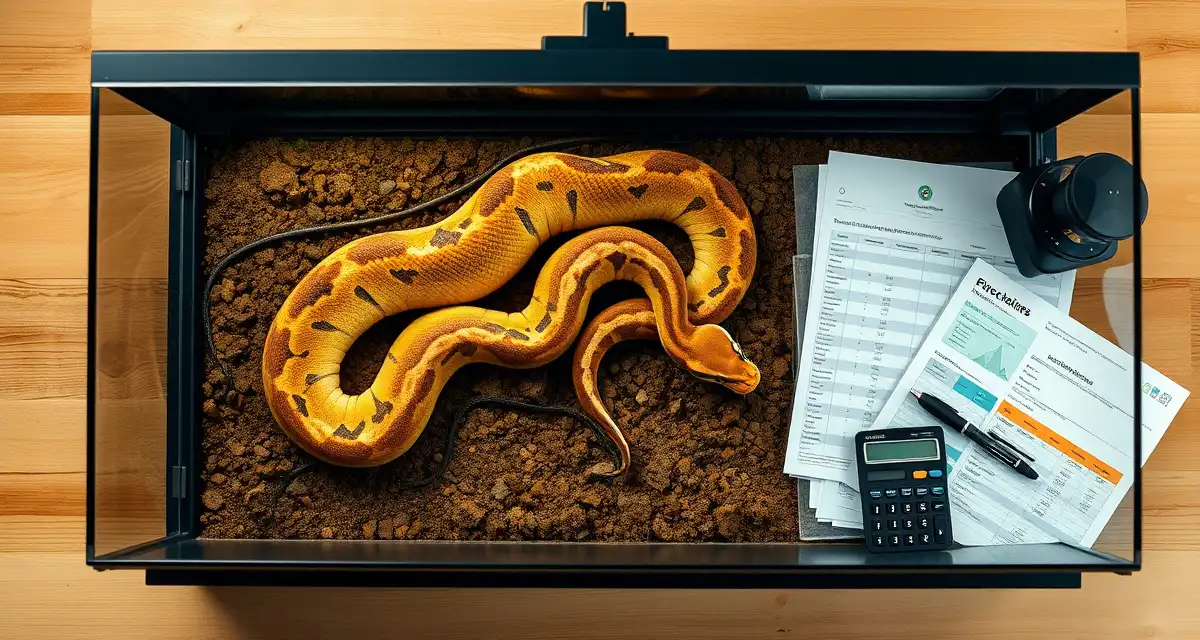
The economics of Burmese python breeding are more demanding than most reptile programs because of the scale of costs involved. A single adult female consumes hundreds of dollars in food annually. Custom large enclosures cost thousands to build. And with regulatory restrictions on sales in multiple states, the effective buyer market is smaller than it would be for ball pythons. Breeders using integrated software report 30% less time on administrative tasks, which matters when the financial stakes of a Burmese breeding program require careful monitoring to ensure the operation is actually profitable.
TL;DR
- Burmese pythons (Python bivittatus) are among the largest constrictors in captivity, with breeding females commonly exceeding 100-200 lbs.
- Clutch sizes average 25-50 eggs, making Burmese pythons among the most productive large constrictors in captive breeding.
- Cycling typically involves a 4-8 week period of reduced temperatures (dropping 8-12 degrees Fahrenheit) and reduced feeding frequency.
- Incubation parameters runs 60-65 days at 88-90 degrees Fahrenheit, with females capable of thermoregulating eggs by muscular shivering.
- Compliance requirements requirements for Burmese python ownership and interstate transport vary by state, with federal protections under the Lacey Act applying in some jurisdictions.
Many Burmese breeders are surprised when they run real numbers on their program for the first time. The feed, housing, electricity, and veterinary costs associated with large constrictors often exceed what casual breeders expect. Getting an accurate financial picture is the first step toward making the program financially sustainable.
Annual Costs Per Animal
The ongoing cost of maintaining a breeding Burmese python includes several categories:
Feed. An adult female at 14 feet eating large rabbits or equivalent prey every 2 weeks spends approximately 26 feeding events per year outside of breeding season. At $20-30 per rabbit, that's $520-780 in annual feed costs for one female. Males are slightly smaller but still significant. This is the largest ongoing expense category for most operations.
Housing. Custom Burmese enclosures cost $500-2,000+ to build depending on size and materials. This is capital expense that depreciates over the animal's useful housing life. Annual electrical costs for heating large enclosures are also meaningful -- a single large enclosure running a 200-watt RHP 24/7 adds roughly $140+ per year in electricity costs depending on your rates.
Veterinary. Annual exams, fecal testing, and any treatment costs. Budget $150-300 per breeding animal per year as a baseline, more if health issues develop.
Your time. Weekly feeding, daily observation, enclosure cleaning, breeding season management, hatchling processing -- the labor component of Burmese breeding is substantial. Assign it a value.
Revenue Potential
Normal Burmese hatchlings sell for $50-150 at current market prices. Morph animals generate significantly more. A clutch of 60 normal hatchlings at average $75 generates $4,500 gross revenue. Subtract production costs and the numbers may not be impressive for a normal Burmese program.
Morph animals change the math substantially. Albino Burmese hatchlings at $300 each from a 30-animal morph clutch generates $9,000 gross. Combination morph animals (Albino Labyrinth, for example) can generate much more per individual. The financial case for Burmese breeding is strongest when you're working with morph genetics that produce premium-priced animals.
Per-Clutch P&L Analysis
The most useful financial tool for a Burmese breeder is per-clutch profit and loss analysis. This takes all costs attributable to a specific breeding season (female's annual maintenance, male's cycling-season costs, incubation costs, hatchling housing and feed) and compares them to actual revenue from that clutch's animals.
Running this analysis for each clutch over multiple seasons tells you whether specific breeding pairs are profitable, whether your morph projects are generating returns that justify the long time investment, and where your costs are highest relative to revenue.
HatchLedger connects husbandry logs to clutch P&L so the cost data you build throughout the year feeds automatically into your per-season financial analysis.
Regulatory Costs
Compliance costs are real financial considerations for Burmese breeders. If your state requires permits, those are expenses. Shipping restrictions that limit your buyer market affect revenue potential. USARK membership for staying informed about regulatory changes has a fee. These aren't large costs but they're legitimate parts of your operation's financial picture.
If you're running a commercial breeding operation, tax compliance is also part of your financial management. Keep records of all deductible expenses and consult a tax professional who understands small business agriculture or hobby income rules, depending on how your operation is classified.
HatchLedger tracks all financial transactions -- costs and revenue -- linked to specific animals and clutches, providing the organized records you need for tax reporting and business analysis.
Frequently Asked Questions
What is the best approach to Burmese python financial tracking?
Track all cost categories for each breeding animal: feed, housing, electricity, veterinary, and time. Record every sale with animal ID, price, and date. Calculate per-clutch P&L for every breeding season by attributing production costs to the clutch they supported and comparing to actual sales revenue. Review your financials annually and use the data to evaluate whether specific breeding pairs and morph projects are generating adequate returns. Don't exclude regulatory and compliance costs from your financial picture.
How do professional breeders handle Burmese python financial tracking?
Professional Burmese breeders run their operations with the financial discipline of a small business because that's what they are. They track all costs consistently throughout the year and calculate actual margins per clutch and per season. They use financial data to make decisions about which animals to retain, which projects to continue, and whether to scale up or down. When feed costs, regulatory restrictions, or market prices change, they reassess their financial model accordingly rather than continuing out of inertia.
What software helps manage Burmese python financial records?
HatchLedger tracks every animal, clutch, and sale record for Burmese python breeders, with documentation that supports regulatory compliance and buyer confidence. When managing large clutches and compliance requirements simultaneously, a connected system prevents the record-keeping gaps that create problems at sale. Free for up to 20 animals.
Are Burmese pythons legal to own and breed in all US states?
No. Burmese pythons are listed as an injurious species under the Lacey Act, which restricts interstate transport. Several states have additional bans on ownership entirely. Check current state and federal regulations before acquiring or transporting animals. USARK maintains updated resources on applicable regulations.
How large should a Burmese python enclosure be for a breeding pair?
Breeding females typically require enclosures of at least 8x4 feet and often larger for full-grown adults. Dedicated breeding rooms or custom builds are standard at scale. Thermal gradient with hot spots at 88-92 degrees Fahrenheit and ambient temperatures in the mid-70s allows proper thermoregulation.
Sources
- USARK (United States Association of Reptile Keepers)
- Association of Reptilian and Amphibian Veterinarians (ARAV)
- US Fish and Wildlife Service (Injurious Wildlife regulations)
- Journal of Herpetology (Society for the Study of Amphibians and Reptiles)
- Florida Fish and Wildlife Conservation Commission
Get Started with HatchLedger
Burmese python breeding involves large animals, large clutches, and compliance documentation that is difficult to manage without a dedicated system. HatchLedger tracks every animal, clutch, and sale record in one place, giving you the documentation you need for regulatory compliance and buyer confidence. Try it free with up to 20 animals.