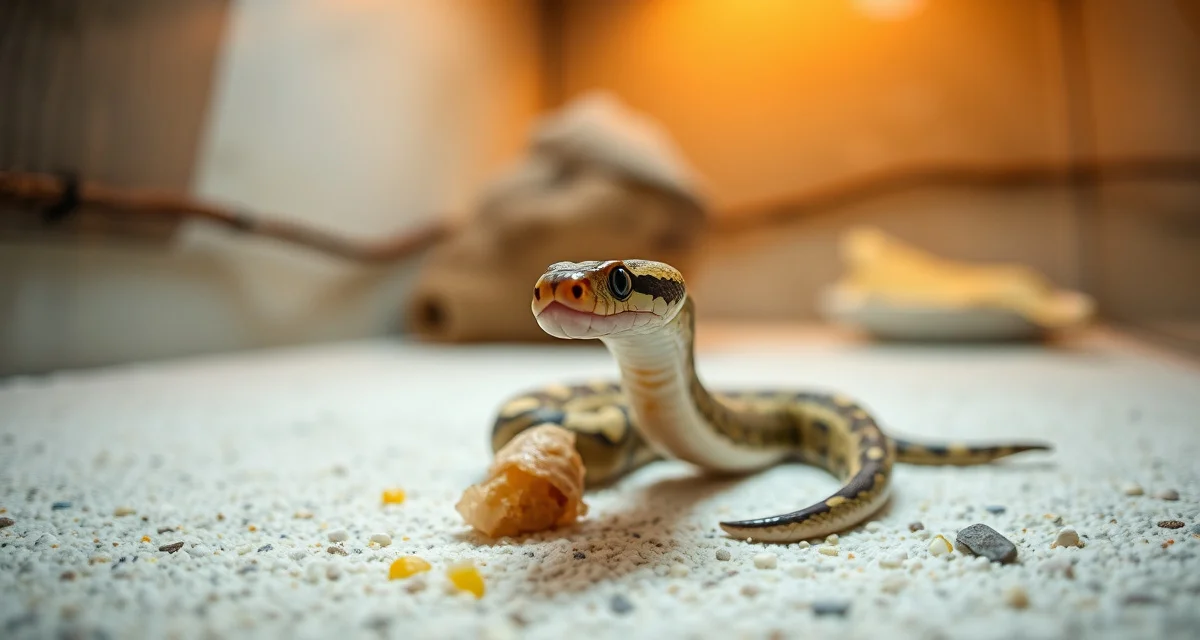
Burmese Python Feeding Hatchlings: Complete Breeder Guide
Burmese python hatchlings are generally among the most enthusiastic feeders in the python world. Where ball pythons might require weeks of careful coaxing to establish feeding, most Burmese hatchlings will strike at appropriately sized prey with minimal hesitation. The challenge isn't usually getting them to eat -- it's managing the high feeding frequency they need to support their extraordinary growth rate. Breeders using integrated software report 30% less time on administrative tasks, and with a large cohort of fast-growing hatchlings all on staggered feeding schedules, that efficiency matters.
TL;DR
- Burmese pythons (Python bivittatus) are among the largest constrictors in captivity, with breeding females commonly exceeding 100-200 lbs.
- Clutch sizes average 25-50 eggs, making Burmese pythons among the most productive large constrictors in captive breeding.
- Cycling typically involves a 4-8 week period of reduced temperatures (dropping 8-12 degrees Fahrenheit) and reduced feeding frequency.
- Incubation parameters runs 60-65 days at 88-90 degrees Fahrenheit, with females capable of thermoregulating eggs by muscular shivering.
- Compliance requirements requirements for Burmese python ownership and interstate transport vary by state, with federal protections under the Lacey Act applying in some jurisdictions.
The fundamentals of feeding Burmese hatchlings are straightforward, but scaling those fundamentals across a 50-80 hatchling cohort requires systematic organization to avoid overfeeding, underfeeding, or simply losing track of who ate last.
Timing the First Meal
Offer the first meal 7-14 days after the first shed is complete. Most hatchlings complete their initial shed within 7-14 days of hatching. After the shed, wait 48-72 hours before the first feeding attempt to allow the animal to settle.
Start with an appropriately sized prey item. For a freshly hatched Burmese (typically 18-24 inches, 80-120 grams), an adult mouse or small rat fuzzy is appropriate. The prey should be roughly the same width as the snake's head. This is a much larger starting prey item than you'd offer ball python hatchlings, reflecting the Burmese hatchling's larger size and faster metabolism.
Offer frozen/thawed prey warmed to approximately 95-100F at the surface. A warm prey item is more attractive to a hatchling with a strong thermal sensing response. Most Burmese hatchlings will constrict and consume F/T prey without hesitation.
Feeding Frequency and Prey Progression
Once established, Burmese hatchlings can be fed every 5-7 days. At this frequency with appropriately sized, incrementally increasing prey items, expect hatchlings to gain 20-40 grams per week in the first few months. Growth rates vary by individual and by how well the feeding schedule is maintained.
Progress prey size in step with the hatchling's growth. As a rough guide, the prey item should be no wider than 1.5 times the diameter of the snake at its widest point. Move from adult mice to rat fuzzies to rat pups to small adult rats as the snake grows. Don't jump prey sizes too aggressively -- a prey item that's too large relative to the snake's current size causes regurgitation and stress.
Track prey size with each feeding record. This helps you scale up appropriately and catch cases where an animal has grown enough to need a size increase without having been reassessed.
Managing a Large Hatchling Cohort
With 50-80 hatchlings from a large Burmese clutch, you need a systematic feeding rotation. Every animal needs to be fed approximately once per week, which means feeding sessions are happening every day when you have multiple cohorts at different points in their feeding cycles.
Organize your hatchling housing so feeding rounds are efficient. Animals that eat in adjacent tubs get serviced in sequence. A feeding day log -- even just a checklist -- prevents you from double-feeding some animals and missing others entirely.
Animals that are eating F/T can be fed via tongs or by placing prey items in the tub. Some breeders prefer tong feeding because it maintains awareness of the hatchling's current prey response and reduces the chance of an animal consuming substrate along with prey. Others use the placement method for speed with large cohorts. Either approach works as long as you're monitoring feeding outcomes.
Log every feeding with date, prey type, prey size, and result. For a large cohort, this seems like a lot of data entry, but it becomes invaluable when an animal goes off feed, regurgitates, or falls behind on growth. You'll know exactly when the problem started and what the prior feeding pattern looked like.
HatchLedger handles individual feeding logs for each hatchling, linked to their unique ID and the parent clutch record. When you're managing a 70-hatchling cohort, the alternative is either a massive spreadsheet or incomplete records.
HatchLedger connects hatchling feeding records to your clutch P&L, tracking food costs as part of your per-animal investment through to sale.
Frequently Asked Questions
What is the best approach to feeding Burmese python hatchlings?
Offer first prey 7-14 days post-first shed with appropriately sized F/T prey warmed to 95-100F. Start with adult mice or small rat fuzzies depending on hatchling size. Feed every 5-7 days and progress prey size in step with the snake's growth. For large cohorts, use a systematic feeding rotation with logs so no animal gets missed or double-fed. Log every feeding outcome individually -- date, prey size, result. Monthly weight checks confirm that your feeding schedule is producing appropriate growth.
How do professional breeders handle Burmese python hatchling feeding at scale?
Professional Burmese breeders treat hatchling feeding as an organized operation, not an ad hoc process. They plan feeding rotations so every animal in the cohort is serviced on schedule, log outcomes for each individual, and use weight tracking to verify growth is on target. When an animal falls behind -- slow growth, consistent refusals, weight loss -- their records show exactly when it started and what the prior pattern was. This makes early intervention more likely and informed. They also track food costs per animal so the total investment in raising each hatchling to sale is known.
What software helps manage Burmese python hatchling feeding records?
HatchLedger tracks every animal, clutch, and sale record for Burmese python breeders, with documentation that supports regulatory compliance and buyer confidence. When managing large clutches and compliance requirements simultaneously, a connected system prevents the record-keeping gaps that create problems at sale. Free for up to 20 animals.
Are Burmese pythons legal to own and breed in all US states?
No. Burmese pythons are listed as an injurious species under the Lacey Act, which restricts interstate transport. Several states have additional bans on ownership entirely. Check current state and federal regulations before acquiring or transporting animals. USARK maintains updated resources on applicable regulations.
How large should a Burmese python enclosure be for a breeding pair?
Breeding females typically require enclosures of at least 8x4 feet and often larger for full-grown adults. Dedicated breeding rooms or custom builds are standard at scale. Thermal gradient with hot spots at 88-92 degrees Fahrenheit and ambient temperatures in the mid-70s allows proper thermoregulation.
Sources
- USARK (United States Association of Reptile Keepers)
- Association of Reptilian and Amphibian Veterinarians (ARAV)
- US Fish and Wildlife Service (Injurious Wildlife regulations)
- Journal of Herpetology (Society for the Study of Amphibians and Reptiles)
- Florida Fish and Wildlife Conservation Commission
Get Started with HatchLedger
Burmese python breeding involves large animals, large clutches, and compliance documentation that is difficult to manage without a dedicated system. HatchLedger tracks every animal, clutch, and sale record in one place, giving you the documentation you need for regulatory compliance and buyer confidence. Try it free with up to 20 animals.