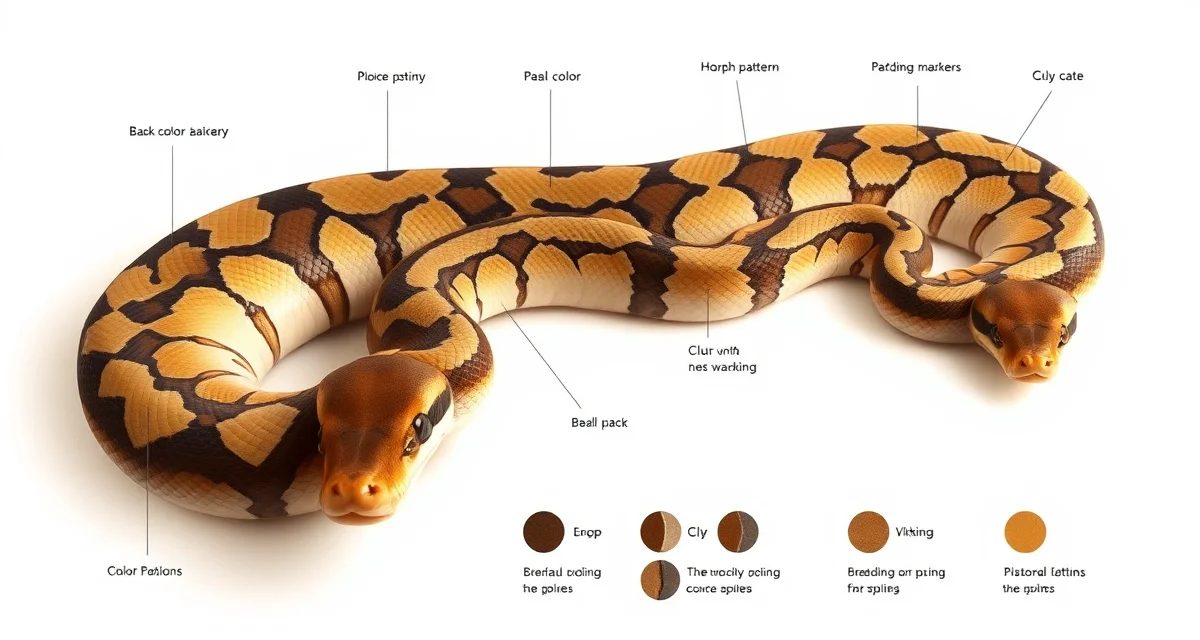
Boa Constrictor Morph Genetics Overview: Complete Breeder Guide
Boa constrictor morph genetics have developed considerably over the past two decades, though the boa morph market is smaller and less complex than the ball python market. The foundation genetics are the same -- recessive, co-dominant, and dominant traits -- but the available morphs and the breeding projects that drive the hobby look quite different. Breeders using integrated software report 30% less time on administrative tasks, which matters when you're running multi-generation morph projects that require years of careful record keeping.
TL;DR
- Boa constrictors are viviparous (live-bearing), with gestation lasting 5-8 months depending on subspecies and husbandry conditions.
- Seasonal cycling typically starts in October with a 5-10 degree Fahrenheit temperature reduction and reduced photoperiod.
- Litter sizes average 15-25 neonates for Boa constrictor imperator, though some localities and true red-tails average smaller litters.
- Confirming pregnancy in boas is subtler than in ball pythons and often requires close behavioral observation or portable ultrasound.
- Logging every pairing date and gestation-period observation gives you the data to accurately predict birth windows and prepare appropriate neonate housing.
Understanding how boa genetics work, which morphs are most commonly worked with, and how to track your genetic lines accurately is essential for any serious boa breeder. Selling visuals at premium prices and maintaining the confidence of buyers in your genetics depends on accurate documentation going back through multiple generations.
Basic Genetic Inheritance in Boas
Boa genetics follow the same Mendelian principles as other reptile genetics. Recessive morphs require two copies of the mutation to produce the visual expression. Co-dominant morphs express visually with one copy and produce a different (often more extreme) expression with two copies (the "super" form). Dominant mutations express with a single copy and may or may not have a viable super form.
In boa breeding, recessive mutations have historically been the most commercially significant. Albino, hypo (hypomelanistic), kahl albino, and sharp albino are among the foundational recessive traits. Co-dominant mutations like Motley, Jungle, and Leopard have become increasingly popular in boa projects over the past decade.
Proving out a new boa is a longer process than in ball pythons because of slower reproduction rates and smaller litter sizes. A ball python breeder might prove out a new recessive in 2-3 years. A boa breeder working with a normal-looking het animal might need 4-5 years of breeding to prove the genetics definitively.
Common Boa Morphs and Their Genetics
Albino -- One of the oldest and most established boa morphs. Recessive. Removes most melanin, producing white-and-yellow animals with red eyes. Multiple albino lines exist (Kahl albino, Sharp albino), and it's important to know whether your animals carry the same line before attempting to combine them -- different albino lines don't always produce visual albinos when crossed.
Hypo (Hypomelanistic) -- Recessive. Reduces melanin, producing lighter ground color with more contrast in the pattern. Hypo boas show a wide range of expression depending on the line and locality.
Motley -- Co-dominant. Disrupts the dorsal pattern into connected circles or irregular shapes. Motley x Motley produces Super Motley, which has a dramatically different appearance -- often a nearly patternless yellow and white animal.
Jungle -- Co-dominant. Creates a highly variable "jungle" pattern with asymmetry, reduced dark coloration, and irregular markings. No two Jungle boas look quite alike, which makes them appealing to collectors.
Leopard -- Co-dominant. Produces a speckled, high-contrast pattern with reduced pattern elements. Super Leopard is pure white.
Sharp albino -- Recessive. A separate albino line from the Kahl albino. Sharp albinos tend to have more lavender coloration in addition to the standard albino characteristics.
Tracking Genetic Lines Accurately
Boa morph genetics require precise line tracking. Because multiple albino lines exist that are not compatible, and because "het" animals from unverified sources may carry incorrect genetics, your records need to document not just the morph but the specific line and provenance of your animals.
When you purchase a het or visual boa for your breeding program, document the seller, the lineage information they provided, and any breeding records they shared. If you can get parent and grandparent information, record it. This protects you against unknowingly working with misrepresented genetics, and it protects your buyers.
HatchLedger lets you track morph genetics alongside breeding history for every animal in your collection. When a neonate is born from a Hypo het Albino x Hypo het Albino pairing, you can document its possible genetic outcomes directly in the record -- visual Hypo, visual Albino, visual Hypo Albino, possible het combinations -- so that your sales listings are accurate.
Genetic Pairing Outcomes
Calculating expected outcomes for boa pairings uses the same Punnett square logic as any other reptile genetics. A het x het recessive cross produces 25% visuals, 50% possible hets, and 25% normals (non-carriers). A visual x normal recessive cross produces 100% possible het offspring.
Where boa genetics get complicated is in multi-morph projects combining both recessive and co-dominant traits. Tracking what you expect from a pairing, what you actually got, and whether the outcomes were consistent with the genetics of the parent animals gives you confidence that your genetic lines are clean. Unexpected outcomes sometimes reveal a parent was not actually a het for the trait you thought -- this is a much easier problem to diagnose when you have complete records.
HatchLedger connects morph genetics to clutch records and P&L, so you can see the financial performance of your genetic projects alongside the biological outcomes.
Frequently Asked Questions
What is the best approach to boa constrictor morph genetics?
Start by understanding the basic inheritance types: recessive, co-dominant, and dominant. Know which morphs you're working with and which specific lines they come from -- this is particularly important with boa albino lines, where different incompatible lines exist. Track genetic information for every animal in your collection, including the provenance of your het animals. Use Punnett squares to calculate expected pairing outcomes, then document actual outcomes against predictions. Discrepancies between expected and actual outcomes sometimes reveal problems with your genetic data that are much better caught early.
How do professional breeders handle boa constrictor morph genetics tracking?
Experienced boa breeders maintain full lineage records for every animal, not just the visual morphs. They document het status, the specific genetic line (particularly for albinos), and the provenance of purchased animals. When producing a litter, they log the expected genetic outcomes per offspring type and track what they actually produced. Over multiple generations, this builds a verified genetic pedigree that supports premium pricing and buyer confidence. Misrepresented genetics destroy reputation -- accurate records protect against both making and transmitting these errors.
What software helps manage boa constrictor morph genetics records?
HatchLedger is purpose-built for reptile breeders, connecting animal records, breeding history, clutch outcomes, and financial tracking in one system. Unlike generic spreadsheets, it's designed around the specific workflow of an active breeding season. Free for up to 20 animals.
How do you sex boa constrictor neonates?
Boa constrictor neonates can be sexed by probing or by popping, both of which should be performed by an experienced keeper to avoid injury. Males typically probe to 4-8 subcaudal scales and females probe to 2-3. Recording sex in your records at birth is important for accurate inventory and sales documentation.
How long does it take a boa constrictor to reach breeding weight?
Most B. c. imperator females reach breeding weight (typically 3,000-5,000g depending on locality) at 3-4 years under good feeding conditions. True red-tailed boas (B. c. constrictor) grow larger and may take 4-5 years. Males of most localities are ready to breed at 18-24 months.
Can boa constrictors produce back-to-back litters in consecutive years?
Most experienced breeders rest females for a full season after a large litter to allow proper body condition recovery. A female that drops significant weight during a long gestation needs adequate recovery time before the next breeding cycle. Tracking body weight before and after gestation is the best guide.
Sources
- USARK (United States Association of Reptile Keepers)
- Association of Reptilian and Amphibian Veterinarians (ARAV)
- Herpetologica (Herpetologists League)
- Reptiles Canada Magazine
- World Animal Protection
Get Started with HatchLedger
Boa constrictor breeding involves months of gestation monitoring, pairing records, and litter documentation that is difficult to track reliably across multiple females using notebooks or generic spreadsheets. HatchLedger gives you a single connected system for all of it, from cycling start through neonate sale. Try it free with up to 20 animals.