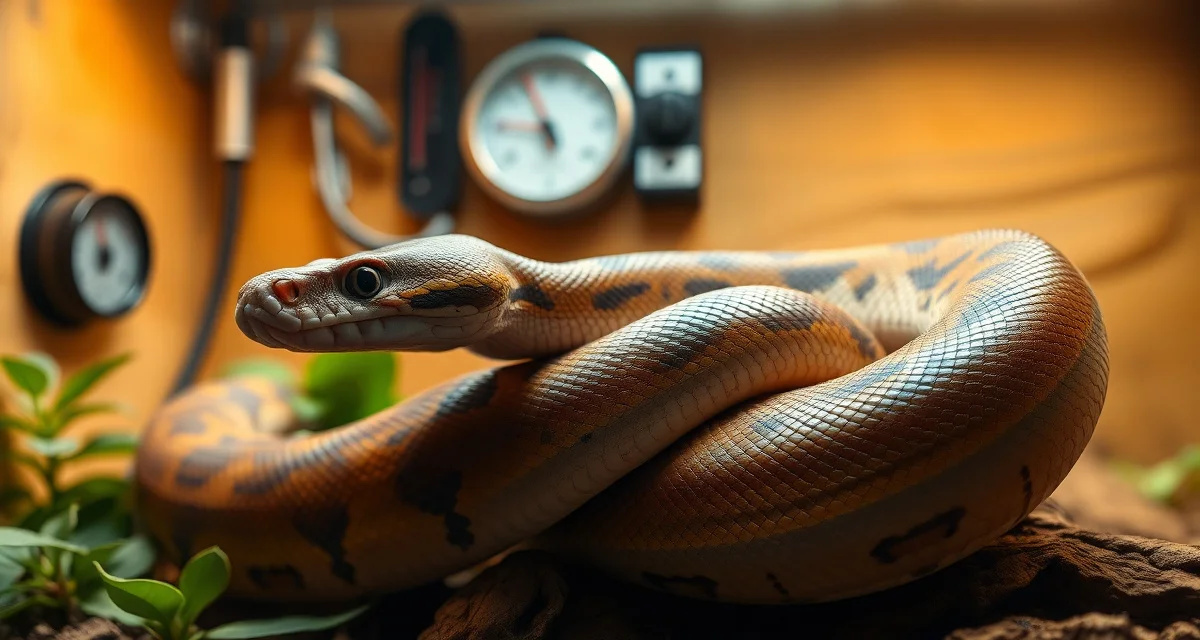
Boa Constrictor Incubation Parameters: Complete Breeder Guide
By HatchLedger Editorial Team · Published 2025-01-30 · Updated Mar 13, 2026
Boa constrictors are livebearers, which means there's no external egg incubation to manage -- the female carries developing young internally throughout gestation. But that doesn't make "incubation parameters" irrelevant. The temperature and humidity conditions you maintain for a gravid female directly determine fetal development outcomes, slug rates, and neonate vitality. Breeders using integrated software report 30% less time on administrative tasks, giving you more time to monitor the gravid females that need consistent attention over a months-long gestation.
TL;DR
- Boa constrictors are viviparous (live-bearing), with gestation lasting 5-8 months depending on subspecies and husbandry conditions.
- Seasonal cycling typically starts in October with a 5-10 degree Fahrenheit temperature reduction and reduced photoperiod.
- Litter sizes average 15-25 neonates for Boa constrictor imperator, though some localities and true red-tails average smaller litters.
- Confirming pregnancy in boas is subtler than in ball pythons and often requires close behavioral observation or portable ultrasound.
- Logging every pairing date and gestation-period observation gives you the data to accurately predict birth windows and prepare appropriate neonate housing.
Treating gravid boa husbandry with the same precision you'd apply to egg incubation is the approach that separates experienced breeders from beginners. Temperature swings, cold stress, or nutritional deficits during gestation produce the same kind of poor outcomes you'd see from a poorly managed incubator -- high stillborn rates, undersized young, and weak neonates.
Temperature Management During Gestation
Once you've confirmed or strongly suspect pregnancy, your temperature management becomes a priority. Gravid females should have consistent access to a warm side of 88-92F and a cooler ambient range around 76-80F. The warm side is particularly important because females will thermoregulate actively, spending extended time in the warm zone to support fetal development.
Avoid temperature drops during gestation. The seasonal cycling you used to trigger breeding is done -- now you want stable, warm conditions for the duration of the pregnancy. If your breeding room undergoes ambient temperature swings (common in facilities that rely on central HVAC without dedicated supplemental heat), gravid females are at risk of temperature stress.
Mid-to-late gestation females often produce noticeable heat through their own metabolism. This is normal and a sign of active fetal development. Don't mistake this for overheating and lower your thermostat -- allow the female to self-regulate using the thermal gradient you've provided.
Humidity During Gestation
Humidity requirements for gravid boas are similar to normal husbandry: aim for 60-70% relative humidity in the enclosure. Higher humidity around 70-80% may be beneficial during the final weeks before birth, particularly during the shed that typically occurs 2-4 weeks before delivery.
Pre-birth sheds are a reliable indicator that birth is approaching. When you notice your gravid female in blue (opaque eyes and dull skin indicating a shed cycle), prepare for birth within 2-4 weeks of the shed completing. If you've been logging her feeding cessation date and the pre-birth shed date, you can narrow your birth window estimate considerably.
Feeding Adjustments for Gravid Females
A gravid boa will often reduce or completely stop feeding at some point during gestation. This is normal behavior and you shouldn't try to force feed unless the female is significantly underweight and showing signs of nutritional deficiency. The digestive process generates heat and pressure that can stress developing fetuses.
The last reliable feeding window for most gravid females is during the first trimester, roughly the first two months after confirmed pregnancy. After that, offer food but don't be concerned about refusals. Some females will take the occasional small meal throughout gestation; others stop entirely after the first month. Both patterns are normal across the species.
Monitoring a Gravid Female
Gravid boas need more frequent monitoring than non-breeding animals. Check your females every 1-3 days during the second half of gestation. You're watching for visible fetal movement, distress behavior (constant movement, rubbing against enclosure walls), labored breathing, or any discharge from the cloaca.
A healthy gravid female spends most of her time motionless in the warm zone, conserving energy. Constant activity or a refusal to settle is sometimes a sign of discomfort or a complication. Keep notes on behavioral changes -- what you observe one week provides the baseline for comparison the next.
HatchLedger gives you a place to log these observations consistently. Temperature records, behavioral notes, feeding refusals, and pre-birth shed dates all feed into the birth record when your female finally delivers. Having this full timeline makes it easy to evaluate what worked and what to adjust for next season.
After Birth: Recovering the Female
Post-birth females need time to recover before their next feeding. Many experienced breeders wait 2-4 weeks after a large litter before offering the first meal. Start with a smaller prey item than you'd normally offer -- a female who just delivered 30+ neonates has been under significant physical stress and needs a gradual return to normal feeding.
Body condition assessment post-birth is essential. Log her weight if possible, note her body condition score, and track her feeding response through the first few weeks. This recovery data informs how quickly you can reasonably bring her back into breeding condition for next season.
HatchLedger connects your female's recovery logs to her full history, so when you're planning next season's pairings, you can see exactly how she bounced back and whether she's ready for another cycle.
Frequently Asked Questions
What is the best approach to boa constrictor gestation (incubation) parameters?
Since boas are livebearers, you're managing the gravid female's environment rather than an incubator. Maintain warm-side temperatures of 88-92F with a cool ambient around 76-80F throughout gestation. Humidity should stay at 60-70%, rising slightly in the final weeks. Avoid temperature drops after breeding season cycling is complete. Monitor feeding behavior -- normal refusals are expected in mid-to-late gestation. Log all behavioral observations and temperature data so you have a complete record when the birth occurs.
How do professional breeders handle boa constrictor gravid female management?
Professionals treat gravid female management as a months-long monitoring process with documented checkpoints. They log temperature data, note the pre-birth shed, track feeding cessation, and watch closely for behavioral changes in late gestation. They also plan housing ahead of the expected birth date, preparing enclosures for neonates so they're not scrambling when 30-40 babies arrive. Post-birth female recovery is tracked just as carefully as the gestation period, since a female's condition after birth determines how soon she can realistically be bred again.
What software helps manage boa constrictor gestation tracking?
HatchLedger is purpose-built for reptile breeders, connecting animal records, breeding history, clutch outcomes, and financial tracking in one system. Unlike generic spreadsheets, it's designed around the specific workflow of an active breeding season. Free for up to 20 animals.
How do you sex boa constrictor neonates?
Boa constrictor neonates can be sexed by probing or by popping, both of which should be performed by an experienced keeper to avoid injury. Males typically probe to 4-8 subcaudal scales and females probe to 2-3. Recording sex in your records at birth is important for accurate inventory and sales documentation.
How long does it take a boa constrictor to reach breeding weight?
Most B. c. imperator females reach breeding weight (typically 3,000-5,000g depending on locality) at 3-4 years under good feeding conditions. True red-tailed boas (B. c. constrictor) grow larger and may take 4-5 years. Males of most localities are ready to breed at 18-24 months.
Can boa constrictors produce back-to-back litters in consecutive years?
Most experienced breeders rest females for a full season after a large litter to allow proper body condition recovery. A female that drops significant weight during a long gestation needs adequate recovery time before the next breeding cycle. Tracking body weight before and after gestation is the best guide.
What is Boa Constrictor Incubation Parameters: Complete Breeder Guide?
Boa Constrictor Incubation Parameters: Complete Breeder Guide is an in-depth reference article on HatchLedger covering the internal gestation conditions that determine healthy boa constrictor births. Because boas are livebearers, 'incubation' means managing the gravid female's environment rather than an egg box. The guide covers gestation length, seasonal cycling, temperature and humidity targets, pregnancy confirmation methods, and record-keeping practices to help breeders predict birth windows and improve neonate vitality.
How much does Boa Constrictor Incubation Parameters: Complete Breeder Guide cost?
The guide is free editorial content published on HatchLedger. There is no purchase required to read it. HatchLedger also offers breeding management software that breeders can use to log pairings, track gestation timelines, and organize records — users of that platform report saving around 30% of their administrative time, freeing them to focus on monitoring gravid females during the critical months-long gestation period.
How does Boa Constrictor Incubation Parameters: Complete Breeder Guide work?
The guide works by translating the biology of boa viviparous reproduction into practical husbandry steps. It explains how to initiate seasonal cycling in October with a 5–10°F temperature drop and reduced photoperiod, how to monitor gravid females for behavioral cues or use portable ultrasound to confirm pregnancy, and how to use consistent environmental parameters throughout the 5–8 month gestation to minimize slug rates and maximize neonate health at birth.
What are the benefits of Boa Constrictor Incubation Parameters: Complete Breeder Guide?
Key benefits include a clear framework for managing gravid female conditions rather than guessing, data-driven strategies to reduce slug rates, and guidance on predicting birth windows by logging pairing dates and gestation observations. Breeders gain confidence identifying pregnancy in boas — which is subtler than in ball pythons — and leave with a repeatable record-keeping system that improves outcomes across successive breeding seasons for both Boa constrictor imperator and true red-tail localities.
Who needs Boa Constrictor Incubation Parameters: Complete Breeder Guide?
This guide is written for serious boa constrictor breeders at any experience level — from hobbyists producing their first litters of BCI to experienced multi-species breeders adding red-tails to their program. It is especially useful for anyone transitioning from egg-laying species who assumes live-bearing snakes require no incubation management, and for breeders who want to build reliable data logs to refine their seasonal cycling and gestation monitoring over multiple breeding seasons.
Related Articles
- Boa Constrictor Buyer Waitlist Management: Complete Breeder Guide
- Boa Constrictor Clutch Size and Egg Count: Complete Breeder Guide
- Boa Constrictor Common Breeding Issues: Complete Breeder Guide
- Boa Constrictor Common Health Issues: Complete Breeder Guide
Sources
- USARK (United States Association of Reptile Keepers)
- Association of Reptilian and Amphibian Veterinarians (ARAV)
- Herpetologica (Herpetologists League)
- Reptiles Canada Magazine
- World Animal Protection
Get Started with HatchLedger
Boa constrictor breeding involves months of gestation monitoring, pairing records, and litter documentation that is difficult to track reliably across multiple females using notebooks or generic spreadsheets. HatchLedger gives you a single connected system for all of it, from cycling start through neonate sale. Try it free with up to 20 animals.