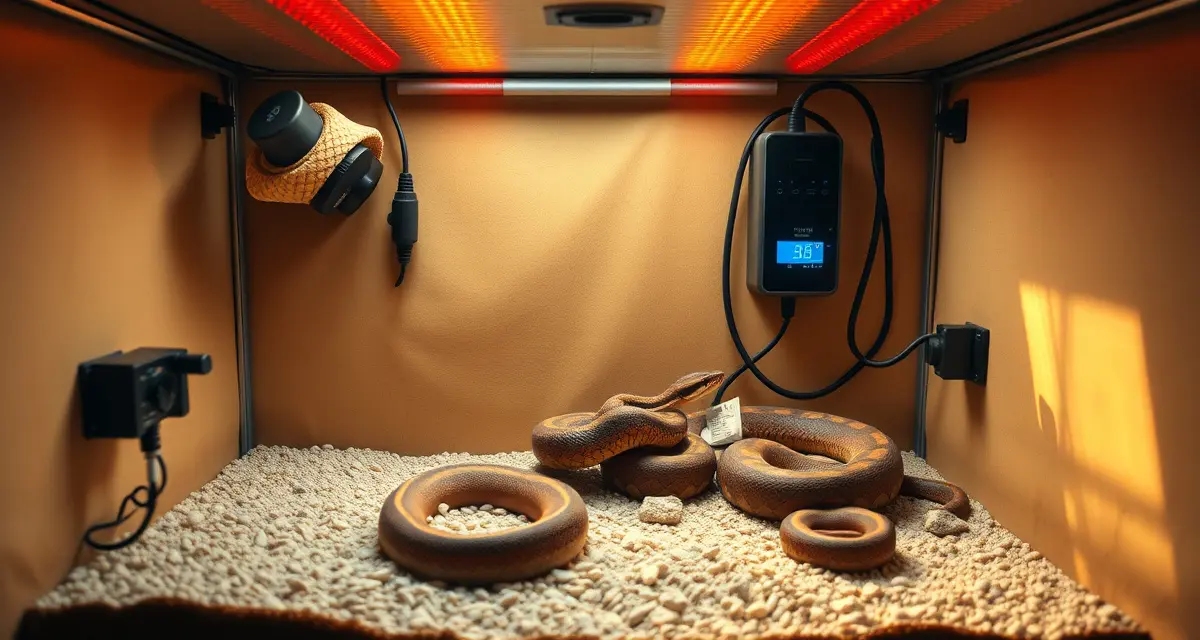
Boa Constrictor Egg Incubation Setup: Complete Breeder Guide
By HatchLedger Editorial Team · Published 2025-02-16 · Updated Mar 13, 2026
Boa constrictors are viviparous snakes -- they give birth to live young rather than laying eggs. So while there's no incubator to set up in the traditional sense, the principles that govern egg incubation in oviparous species (temperature consistency, humidity, minimal disturbance) apply directly to managing a gravid boa through her gestation period. Breeders using integrated software report 30% less time on administrative tasks, giving you more bandwidth to monitor gravid females through the 5-8 month gestation that replaces the 60-day incubation period you'd manage with an egg-laying species.
TL;DR
- Boa constrictors are viviparous (live-bearing), with gestation lasting 5-8 months depending on subspecies and husbandry conditions.
- Seasonal cycling typically starts in October with a 5-10 degree Fahrenheit temperature reduction and reduced photoperiod.
- Litter sizes average 15-25 neonates for Boa constrictor imperator, though some localities and true red-tails average smaller litters.
- Confirming pregnancy in boas is subtler than in ball pythons and often requires close behavioral observation or portable ultrasound.
- Logging every pairing date and gestation-period observation gives you the data to accurately predict birth windows and prepare appropriate neonate housing.
Understanding the parallels between external incubation and boa gestation management helps breeders treat gravid female care with the same precision they'd apply to an incubator setup.
Temperature: The Core Variable
In external incubation, temperature is everything -- a few degrees in either direction changes hatch rates, incubation duration, and sometimes sex ratios in temperature-dependent species. In boa gestation management, the same principle applies. A gravid boa that experiences temperature instability, cold spikes, or inadequate access to her warm zone will produce smaller litters with higher rates of slugs and stillborn young.
Your target warm-side temperature for a gravid boa is 88-92F, consistent throughout the gestation period. The ambient cool side should stay around 76-80F to maintain a functional gradient. The key word is "consistent" -- this means checking your thermostats regularly, verifying probe placement hasn't shifted, and monitoring actual enclosure temperatures rather than assuming your equipment is performing as set.
During winter months (which overlaps with boa gestation for most Northern Hemisphere breeders), ambient room temperatures may dip. A thermostat set to maintain 90F warm-side will compensate for moderate ambient drops, but if your room gets significantly colder overnight, the heating system may not be able to keep up. Supplemental room heating during gestation season is worth considering if your facility has significant ambient temperature swings.
Humidity Management for Gravid Females
Humidity targets for gravid boas are 60-70% -- essentially the same as standard maintenance. Where things matter most is during the pre-birth period. In the final 2-4 weeks before delivery, many breeders slightly increase humidity to 70-80% to support what is effectively a late-stage "incubation" environment.
A pre-birth shed occurs in most gravid females 2-4 weeks before delivery. This shed is analogous to the pre-hatch shed that occurs in embryos before they pip from an egg. Ensuring the female can complete a clean, stress-free shed during this critical period means maintaining adequate humidity and a properly sized humid hide.
Monitor your actual enclosure humidity with a digital hygrometer rather than estimating based on substrate moisture. Humidity fluctuates significantly based on substrate type, ventilation, and ambient room humidity.
Monitoring the "Incubation" Period
In a traditional incubator, you're checking eggs daily, monitoring temperature and humidity logs, and watching for any signs of mold, collapsed eggs, or temperature drift. With a gravid boa, your daily monitoring involves the female herself.
Check gravid females every 1-3 days. Note behavioral changes: more time in the warm zone is normal and expected. Unusual restlessness, respiratory changes, or discharge from the cloaca are red flags that warrant veterinary attention. Note visible changes in abdominal contour as gestation progresses -- gradual expansion of the posterior third of the body is a normal sign of fetal development.
Keep a running log of observations during the gestation period. Temperature readings, behavioral notes, feeding refusals, and pre-birth shed dates all matter.
Setting Up a Birth Area
In a traditional incubator setup, you prepare a neonate tub and have it ready before eggs hatch. For boa gestation, you prepare a birth area before delivery. This means having neonate housing ready, individual labels prepared, a scale for weighing neonates, and a clean workspace.
Some breeders move gravid females to a dedicated birth enclosure in the final weeks. This can be larger and easier to access than their normal housing, which helps during the birth observation and neonate separation process. Others leave females in their normal enclosures and prepare those for birth instead.
HatchLedger lets you log the full gestation timeline -- from confirmed breeding through pre-birth shed to actual birth date -- and link all of that to the birth record. This mirrors the way egg incubation logs work for oviparous species.
HatchLedger connects your gestation management records to clutch P&L, giving you a complete picture of the season's investment and outcomes.
Frequently Asked Questions
What is the best approach to boa constrictor gestation management (in place of egg incubation)?
Maintain warm-side temperatures at 88-92F throughout gestation with a cool ambient of 76-80F. Keep humidity at 60-70%, increasing to 70-80% in the final weeks. Monitor the gravid female every 1-3 days and log behavioral changes, temperature readings, and feeding status. Watch for the pre-birth shed that typically occurs 2-4 weeks before delivery. Prepare neonate housing before you expect delivery so you're ready to separate young immediately after birth.
How do professional breeders handle boa constrictor gestation monitoring?
Professional breeders treat gestation management with the same discipline they'd apply to an external incubator. They log temperature data regularly, check on gravid females consistently, and note every behavioral change during the 5-8 month gestation period. They also prepare neonate housing in advance so birth management is organized rather than reactive. The pre-birth shed is tracked specifically because it's the most reliable near-term predictor of delivery timing.
What software helps manage boa constrictor gestation records?
HatchLedger is purpose-built for reptile breeders, connecting animal records, breeding history, clutch outcomes, and financial tracking in one system. Unlike generic spreadsheets, it's designed around the specific workflow of an active breeding season. Free for up to 20 animals.
How do you sex boa constrictor neonates?
Boa constrictor neonates can be sexed by probing or by popping, both of which should be performed by an experienced keeper to avoid injury. Males typically probe to 4-8 subcaudal scales and females probe to 2-3. Recording sex in your records at birth is important for accurate inventory and sales documentation.
How long does it take a boa constrictor to reach breeding weight?
Most B. c. imperator females reach breeding weight (typically 3,000-5,000g depending on locality) at 3-4 years under good feeding conditions. True red-tailed boas (B. c. constrictor) grow larger and may take 4-5 years. Males of most localities are ready to breed at 18-24 months.
Can boa constrictors produce back-to-back litters in consecutive years?
Most experienced breeders rest females for a full season after a large litter to allow proper body condition recovery. A female that drops significant weight during a long gestation needs adequate recovery time before the next breeding cycle. Tracking body weight before and after gestation is the best guide.
What is Boa Constrictor Egg Incubation Setup: Complete Breeder Guide?
This guide covers the complete reproductive management process for boa constrictors, clarifying a common misconception: boas are viviparous and give birth to live young, not eggs. Rather than incubator setup, breeders must manage a 5-8 month gestation period. The guide covers seasonal cycling, pregnancy confirmation, gestation monitoring, and neonate preparation — applying the same principles of temperature consistency and minimal disturbance that govern traditional egg incubation in oviparous species.
How much does Boa Constrictor Egg Incubation Setup: Complete Breeder Guide cost?
The husbandry knowledge in this guide is free to apply, though dedicated reptile breeding management software like HatchLedger offers paid plans to help breeders log pairings, track gestation timelines, and predict birth windows. Breeders using integrated tracking software report spending roughly 30% less time on administrative tasks, freeing more attention for monitoring gravid females throughout the extended gestation period.
How does Boa Constrictor Egg Incubation Setup: Complete Breeder Guide work?
Boa breeding management begins with seasonal cycling in October — reducing temperatures by 5-10°F and shortening photoperiod to trigger breeding behavior. After successful pairing, breeders monitor the female for behavioral and physical signs of pregnancy, sometimes using portable ultrasound for confirmation. Throughout the 5-8 month gestation, consistent temperatures, reduced handling, and careful observation replace the active incubator management required for egg-laying species.
What are the benefits of Boa Constrictor Egg Incubation Setup: Complete Breeder Guide?
This guide helps breeders avoid costly mistakes by understanding boa-specific reproductive biology rather than applying egg-incubation logic incorrectly. Key benefits include accurate birth window prediction through detailed pairing and gestation logs, better neonate preparation, and improved female health outcomes from proper gravid-female husbandry. Litter sizes averaging 15-25 neonates mean preparation matters — having housing and records ready before birth significantly reduces neonate management stress.
Who needs Boa Constrictor Egg Incubation Setup: Complete Breeder Guide?
This guide is essential for first-time boa breeders who may expect an egg-incubation process similar to ball pythons or other oviparous species. It also benefits experienced breeders looking to systematize records across multiple gravid females. Anyone working with Boa constrictor imperator or true red-tail subspecies will find the gestation-monitoring framework and litter-size benchmarks directly applicable to improving breeding program outcomes.
Related Articles
- Burmese Python Egg Incubation Setup: Complete Breeder Guide
- Carpet Python Egg Incubation Setup: Complete Breeder Guide
- Corn Snake Egg Incubation Setup: Complete Breeder Guide
- Green Tree Python Egg Incubation Setup: Complete Breeder Guide
Sources
- USARK (United States Association of Reptile Keepers)
- Association of Reptilian and Amphibian Veterinarians (ARAV)
- Herpetologica (Herpetologists League)
- Reptiles Canada Magazine
- World Animal Protection
Get Started with HatchLedger
Boa constrictor breeding involves months of gestation monitoring, pairing records, and litter documentation that is difficult to track reliably across multiple females using notebooks or generic spreadsheets. HatchLedger gives you a single connected system for all of it, from cycling start through neonate sale. Try it free with up to 20 animals.