Boa Constrictor Compliance and Shipping: Complete Breeder Guide
By HatchLedger Editorial Team · Published 2025-06-04 · Updated Mar 13, 2026
Shipping boa constrictors involves legal and practical considerations that differ meaningfully from shipping ball pythons or other commonly traded species. Boa constrictors occupy a complicated regulatory space in the US because certain subspecies are federally regulated and some states have enacted restrictions that apply to all boas. Breeders using integrated software report 30% less time on administrative tasks, leaving more time to stay current on the regulatory landscape and ensure your shipping practices hold up under scrutiny.
TL;DR
- Boa constrictors are viviparous (live-bearing), with gestation lasting 5-8 months depending on subspecies and husbandry conditions.
- Seasonal cycling typically starts in October with a 5-10 degree Fahrenheit temperature reduction and reduced photoperiod.
- Litter sizes average 15-25 neonates for Boa constrictor imperator, though some localities and true red-tails average smaller litters.
- Confirming pregnancy in boas is subtler than in ball pythons and often requires close behavioral observation or portable ultrasound.
- Logging every pairing date and gestation-period observation gives you the data to accurately predict birth windows and prepare appropriate neonate housing.
Getting compliance wrong isn't just an administrative inconvenience -- it can result in fines, confiscated animals, and permanent damage to your reputation as a seller. Understanding what applies to your specific animals and what your obligations are before you ship a single animal is essential.
Federal Regulations: The Lacey Act and USARK
The Lacey Act prohibits interstate commerce in wildlife that was taken or traded in violation of state or foreign law. For boa constrictors, the relevant federal regulatory history involves a 2012 federal rule that listed four large constrictors as injurious wildlife under the Lacey Act -- but boa constrictors (B. constrictor and B. imperator) were NOT included in that final rule. So at the federal level, common boa constrictors and common boas are not restricted as injurious wildlife.
However, regulatory landscapes change. USARK (United States Association of Reptile Keepers) is the primary advocacy organization monitoring federal reptile regulations. Staying connected to USARK updates is good practice for any boa breeder engaged in interstate commerce.
State-Level Restrictions
This is where boa shipping gets complicated. Multiple states restrict or prohibit boa constrictor ownership and importation, including:
- Puerto Rico -- Boas are prohibited (strict enforcement as an invasive species concern)
- New York City -- Restricts large constrictors
- Hawaii -- Prohibits all boa constrictors
- Florida -- Specific permit requirements apply for some species; remains a gray area for common boas depending on locality
Before you ship any animal interstate, research the destination state's current regulations. Laws change, and regulations that were permissive a few years ago may have been updated. Always check with the recipient that they can legally possess the species you're shipping and that no state permit is required.
Keep records of your compliance research, particularly if a buyer asks you to ship to a state you have questions about. Documentation of your due diligence protects you if questions arise later.
Shipping Logistics: Carriers and Methods
FedEx and UPS both prohibit live animal shipments from individual shippers under standard terms of service. Live reptile shipping legally requires an account through Delta Cargo (Delta Airlines), other commercial live animal cargo services, or a licensed reptile shipping service. Many reptile breeders use Reptiles Express or similar specialized services.
Weather constraints are strict. Most experienced breeders ship live snakes only when:
- Origin temperatures are between 40-90F
- Destination temperatures are between 40-90F
- No extreme weather events (ice storms, heat waves) are forecast along the route
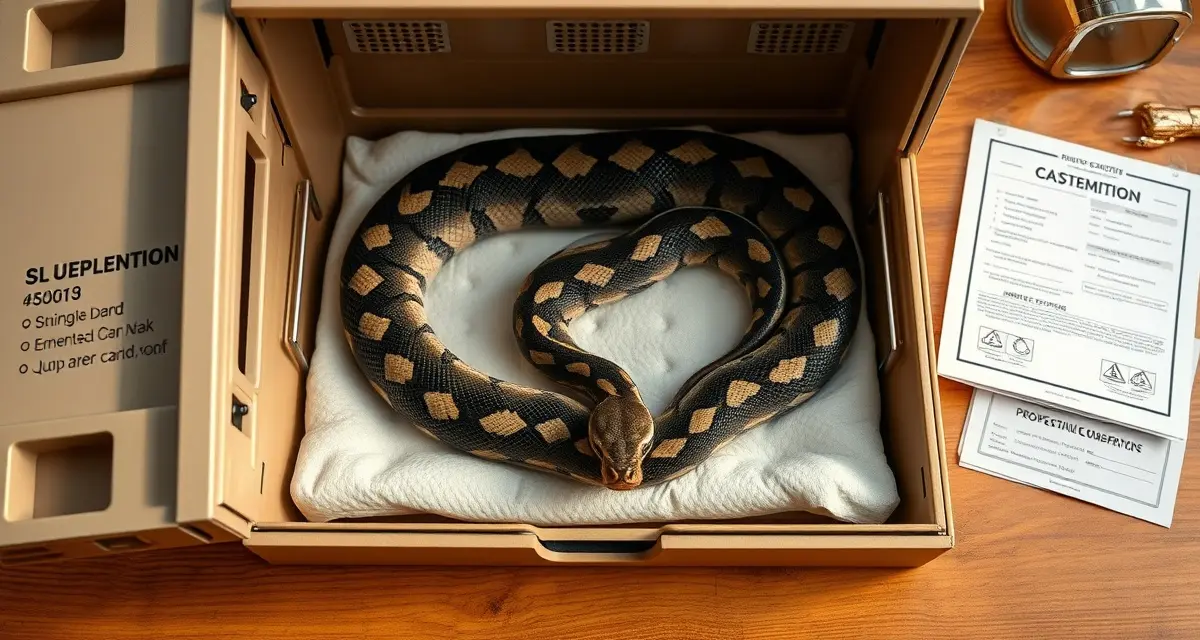
Heat packs (40-hour formulation) are used in cold weather. Cold packs are less commonly used for snakes and require careful placement to avoid cold-shocking animals. Pack snakes in breathable cloth bags inside a styrofoam-lined box with appropriate padding.
Ship overnight and track the package. Buyers should be home and ready to receive the animal on arrival day. Coordinate with your buyer on shipping day and provide the tracking number immediately.
Handling DOA Claims
Document every animal before shipping: photos of the snake healthy and in the shipping container. This creates a baseline that protects you if a DOA claim is made after poor handling on the buyer's end.
Your sale terms should clearly state your shipping and arrival policy. Industry standard is typically a 24-hour live arrival guarantee contingent on: the buyer being home on arrival day, the package being opened immediately, and the buyer contacting you within 24 hours with photos if a problem is found. Animals that sit unattended through a missed delivery attempt are not typically covered.
Keep shipping records for every transaction: animal ID, buyer, ship date, tracking number, arrival confirmation, and any post-arrival communication. These records matter if a transaction becomes disputed.
HatchLedger lets you log sale and shipping information for each animal, connecting the transaction to the animal's full record.
HatchLedger keeps shipping costs as part of your P&L, so your revenue net of shipping is accurately tracked.
Frequently Asked Questions
What is the best approach to boa constrictor compliance and shipping?
Research destination state laws before every interstate shipment, because regulations vary widely and change over time. Use appropriate shipping carriers and methods -- not standard parcel services. Ship only in appropriate weather conditions. Document animal condition before shipping and have clear sale terms that specify your live arrival policy. Keep shipping records that link to individual animal IDs and include tracking numbers, ship dates, and arrival confirmations. Stay current on federal regulatory changes through USARK communications.
How do professional breeders handle boa constrictor shipping compliance?
Professional boa breeders maintain active awareness of both federal and state-level regulations, check destination state laws before every shipment, and keep records that demonstrate compliance. They use proper shipping services and weather-appropriate packaging, and they have clearly documented sale terms that protect both parties. Their shipping records are organized well enough that if any transaction is questioned, they can quickly produce documentation of what was shipped, when, to whom, and in what condition.
What software helps manage boa constrictor shipping and compliance records?
HatchLedger is purpose-built for reptile breeders, connecting animal records, breeding history, clutch outcomes, and financial tracking in one system. Unlike generic spreadsheets, it's designed around the specific workflow of an active breeding season. Free for up to 20 animals.
How do you sex boa constrictor neonates?
Boa constrictor neonates can be sexed by probing or by popping, both of which should be performed by an experienced keeper to avoid injury. Males typically probe to 4-8 subcaudal scales and females probe to 2-3. Recording sex in your records at birth is important for accurate inventory and sales documentation.
How long does it take a boa constrictor to reach breeding weight?
Most B. c. imperator females reach breeding weight (typically 3,000-5,000g depending on locality) at 3-4 years under good feeding conditions. True red-tailed boas (B. c. constrictor) grow larger and may take 4-5 years. Males of most localities are ready to breed at 18-24 months.
Can boa constrictors produce back-to-back litters in consecutive years?
Most experienced breeders rest females for a full season after a large litter to allow proper body condition recovery. A female that drops significant weight during a long gestation needs adequate recovery time before the next breeding cycle. Tracking body weight before and after gestation is the best guide.
What is Boa Constrictor Compliance and Shipping: Complete Breeder Guide?
This guide is a comprehensive resource for boa constrictor breeders navigating the legal and logistical complexities of shipping live animals. It covers federal regulations around certain subspecies, state-level restrictions, documentation requirements, and best practices for compliant transport. The guide is published on HatchLedger and is designed to help breeders stay current on a regulatory landscape that differs significantly from other commonly traded snake species like ball pythons.
How much does Boa Constrictor Compliance and Shipping: Complete Breeder Guide cost?
The guide is free to access on HatchLedger. There is no purchase required to read the compliance and shipping information. HatchLedger does offer breeding management software that breeders can use to reduce administrative workload—users report saving around 30% of time on paperwork—but accessing the article itself costs nothing.
How does Boa Constrictor Compliance and Shipping: Complete Breeder Guide work?
The guide walks breeders through the key compliance steps involved in shipping boa constrictors: identifying which subspecies face federal oversight, checking destination state restrictions, preparing required documentation, and selecting appropriate shipping methods. It also covers practical husbandry context, including gestation tracking and neonate preparation, so breeders can time shipments around birth windows and animal readiness.
What are the benefits of Boa Constrictor Compliance and Shipping: Complete Breeder Guide?
The primary benefit is reducing legal and logistical risk when shipping boas across state lines. Breeders gain a clear framework for understanding which regulations apply to their animals, how to document pairings and births accurately, and how to avoid common compliance mistakes. Integrated record-keeping tools referenced in the guide can also cut administrative time significantly, freeing breeders to focus on animal care.
Who needs Boa Constrictor Compliance and Shipping: Complete Breeder Guide?
Any breeder producing or selling boa constrictors in the US should read this guide, particularly those shipping animals interstate. It is especially relevant for breeders working with subspecies like Boa constrictor imperator or true red-tails, where federal or state-level restrictions may apply. New breeders learning compliance basics and experienced breeders auditing their current practices will both find actionable information here.
Related Articles
- Boa Constrictor Buyer Waitlist Management: Complete Breeder Guide
- Boa Constrictor Clutch Size and Egg Count: Complete Breeder Guide
- Boa Constrictor Common Health Issues: Complete Breeder Guide
- Boa Constrictor Egg Incubation Setup: Complete Breeder Guide
Sources
- USARK (United States Association of Reptile Keepers)
- Association of Reptilian and Amphibian Veterinarians (ARAV)
- Herpetologica (Herpetologists League)
- Reptiles Canada Magazine
- World Animal Protection
Get Started with HatchLedger
Boa constrictor breeding involves months of gestation monitoring, pairing records, and litter documentation that is difficult to track reliably across multiple females using notebooks or generic spreadsheets. HatchLedger gives you a single connected system for all of it, from cycling start through neonate sale. Try it free with up to 20 animals.