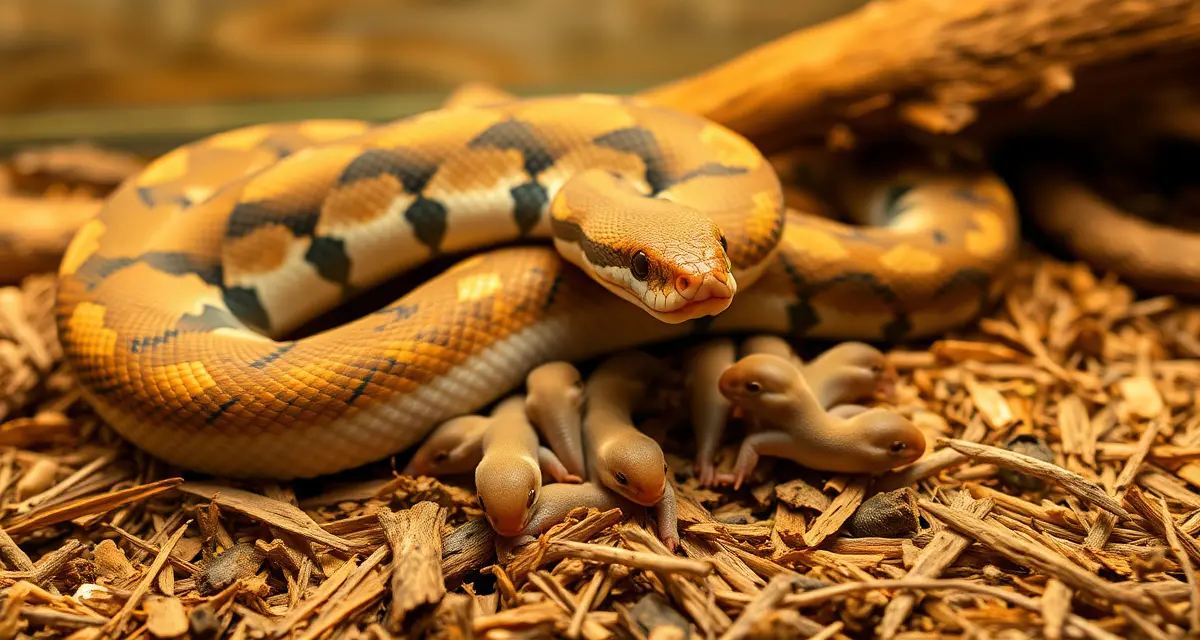
Boa Constrictor Clutch Size and Egg Count: Complete Breeder Guide
By HatchLedger Editorial Team · Published 2025-04-04 · Updated Mar 13, 2026
Boa constrictors are livebearers, so "clutch size" in the traditional sense doesn't apply -- but litter size is just as important a metric for planning your breeding program. A typical boa litter ranges from 10 to 60 neonates, with wild variation based on the female's age, body weight, subspecies, and nutritional condition going into the breeding season. Breeders using integrated software report 30% less time on administrative tasks, leaving more capacity to manage large litters properly when they arrive.
TL;DR
- Boa constrictors are viviparous (live-bearing), with gestation lasting 5-8 months depending on subspecies and husbandry conditions.
- Seasonal cycling typically starts in October with a 5-10 degree Fahrenheit temperature reduction and reduced photoperiod.
- Litter sizes average 15-25 neonates for Boa constrictor imperator, though some localities and true red-tails average smaller litters.
- Confirming pregnancy in boas is subtler than in ball pythons and often requires close behavioral observation or portable ultrasound.
- Logging every pairing date and gestation-period observation gives you the data to accurately predict birth windows and prepare appropriate neonate housing.
Understanding what factors drive litter size -- and tracking them systematically across seasons -- is how serious boa breeders optimize their programs. A female that consistently produces smaller litters may be underconditioned, cycled too aggressively, or simply reaching the end of her productive years. A first-time mother typically produces fewer young than a four- or five-year-old female at her peak reproductive weight.
What Determines Boa Litter Size
The most reliable predictor of boa litter size is the female's body condition and weight going into the breeding season. Females that enter breeding season lean or recovering from a health issue consistently produce smaller litters than well-fed animals at healthy weight. Most experienced breeders aim to breed females that are neither underweight nor obese -- females that carry too much fat can have reproductive complications.
Age matters significantly in boas. Females bred at minimum breeding weight (usually 3-4 kg for common boas, depending on the subspecies) often produce their first small litter of 10-20 young. As they mature and grow, litter sizes typically increase through their peak years. Very old females (15+ years) may produce smaller litters again as reproductive output naturally declines.
Genetics and locality play a role as well. True red-tailed boas (B. c. constrictor) from Guyana or Suriname often produce smaller litters (8-20 young) than common boas (B. imperator), which frequently produce 20-40+ young per litter. Argentine boas are known for large litters, sometimes exceeding 40 neonates in prime females.
Stillborn Young and Slugs
Every boa litter includes some percentage of stillborn or underdeveloped young, often called slugs (undeveloped embryos absorbed into a membranous sac). A small number of slugs per litter -- 1-3 in an otherwise healthy birth -- is normal and not a cause for concern. However, if more than 20-30% of a litter is slugs or stillborn, it's worth examining your management practices.
Common causes of high slug rates include inadequate male fertility, insufficient copulation events, female nutritional deficiency, or incubation temperature problems. In boas, temperature stability during gestation directly affects fetal development. Females kept at inconsistent temperatures or exposed to cold stress during gestation will produce higher rates of slugs and stillborn young.
Document every birth in detail: total young born alive, total stillborn, total slugs, and approximate birth weights. This record becomes your baseline for evaluating that female across multiple breeding seasons.
Tracking Litter Records Across Seasons
A single litter record is useful. Four or five litter records from the same female are invaluable. When you can see that a female consistently produces 25-30 live young per litter across three seasons, that tells you she's a reliable producer. When you see that litter size dropped from 28 to 14 between seasons, you can investigate what changed -- feeding protocol, cycling intensity, male pairing history, or the female's health.
HatchLedger keeps all your litter records linked to parent pairs so you can compare across seasons without digging through paper notebooks or spreadsheets. You can see at a glance whether your females are trending up or down in productivity, which informs your breeding decisions for next season.
Calculating Litter Value
Boa litter value varies dramatically based on morph combinations. A litter of common normals might average $50-100 per neonate at the lower end of the market, while a litter of Hypo Motley x Motley crosses can produce animals worth several hundred dollars each. Knowing your expected litter value before the season helps you prioritize pairings and allocate resources effectively.
HatchLedger connects husbandry logs to clutch P&L so you can calculate the revenue potential of each litter against your breeding costs. Feed costs, housing costs, and time investment all factor into whether a particular pairing makes financial sense for your program.
Frequently Asked Questions
What is the best approach to boa constrictor clutch (litter) size and egg count?
Since boas are livebearers, you're tracking litter size rather than egg count. Document every birth with a full breakdown: live young, stillborn, slugs, and individual birth weights where possible. Track this data against the female's pre-breeding weight and body condition to build a picture of what drives her best litter sizes. Females at healthy breeding weight with good nutritional history consistently outperform underconditioned animals. Compare litter records across seasons to identify trends and adjust your management accordingly.
How do professional breeders handle boa constrictor litter size tracking?
Professional boa breeders treat litter records as longitudinal data, not isolated events. They track each female's litter size, slug rate, and neonate birth weights across multiple seasons and look for patterns. When a female's productivity declines, they investigate whether the cause is age, body condition, male fertility, or husbandry changes. They also use historical litter records when calculating the expected return on investment for specific pairings, particularly when working with expensive morph projects that require several seasons to come together.
What software helps manage boa constrictor litter size and breeding records?
HatchLedger is purpose-built for reptile breeders, connecting animal records, breeding history, clutch outcomes, and financial tracking in one system. Unlike generic spreadsheets, it's designed around the specific workflow of an active breeding season. Free for up to 20 animals.
How do you sex boa constrictor neonates?
Boa constrictor neonates can be sexed by probing or by popping, both of which should be performed by an experienced keeper to avoid injury. Males typically probe to 4-8 subcaudal scales and females probe to 2-3. Recording sex in your records at birth is important for accurate inventory and sales documentation.
How long does it take a boa constrictor to reach breeding weight?
Most B. c. imperator females reach breeding weight (typically 3,000-5,000g depending on locality) at 3-4 years under good feeding conditions. True red-tailed boas (B. c. constrictor) grow larger and may take 4-5 years. Males of most localities are ready to breed at 18-24 months.
Can boa constrictors produce back-to-back litters in consecutive years?
Most experienced breeders rest females for a full season after a large litter to allow proper body condition recovery. A female that drops significant weight during a long gestation needs adequate recovery time before the next breeding cycle. Tracking body weight before and after gestation is the best guide.
What is Boa Constrictor Clutch Size and Egg Count: Complete Breeder Guide?
Boa constrictors are live-bearing (viviparous) reptiles, meaning they give birth to fully developed neonates rather than laying eggs. This guide covers litter size ranges (typically 10–60 neonates), the factors that influence how many babies a female produces, gestation timelines of 5–8 months, and how to track breeding data systematically to improve outcomes across your program.
How much does Boa Constrictor Clutch Size and Egg Count: Complete Breeder Guide cost?
This is a free educational guide published on HatchLedger. There is no purchase required to access the breeding information. HatchLedger also offers breeding management software that breeders can use to log pairings, track gestation windows, and manage neonate records — reducing administrative time so you can focus on animal care.
How does Boa Constrictor Clutch Size and Egg Count: Complete Breeder Guide work?
The guide walks breeders through the full boa reproductive cycle: initiating seasonal cycling in October with temperature and photoperiod reductions, confirming pregnancy through behavioral observation or ultrasound, estimating litter size based on female age and body weight, and preparing appropriate housing before birth. It emphasizes logging each pairing and observation to build predictive data over multiple seasons.
What are the benefits of Boa Constrictor Clutch Size and Egg Count: Complete Breeder Guide?
Systematic litter tracking helps breeders predict birth windows more accurately, prepare neonate housing in advance, and identify which females consistently produce larger or smaller litters. Breeders using integrated record-keeping software report 30% less time on administrative tasks, which is especially valuable when managing the high neonate counts common in boa litters.
Who needs Boa Constrictor Clutch Size and Egg Count: Complete Breeder Guide?
This guide is aimed at boa constrictor breeders of any experience level — from hobbyists producing their first litter to professional breeders managing multiple females across subspecies like Boa constrictor imperator and true red-tails. Anyone who wants to move from guesswork to data-driven breeding decisions will benefit from the tracking frameworks and litter size benchmarks covered.
Related Articles
- Green Tree Python Clutch Size and Egg Count: Complete Breeder Guide
- Hognose Snake Clutch Size and Egg Count: Complete Breeder Guide
- Kingsnake Clutch Size and Egg Count: Complete Breeder Guide
- Milk Snake Clutch Size and Egg Count: Complete Breeder Guide
Sources
- USARK (United States Association of Reptile Keepers)
- Association of Reptilian and Amphibian Veterinarians (ARAV)
- Herpetologica (Herpetologists League)
- Reptiles Canada Magazine
- World Animal Protection
Get Started with HatchLedger
Boa constrictor breeding involves months of gestation monitoring, pairing records, and litter documentation that is difficult to track reliably across multiple females using notebooks or generic spreadsheets. HatchLedger gives you a single connected system for all of it, from cycling start through neonate sale. Try it free with up to 20 animals.