Boa Constrictor Breeder Setup and Housing: Complete Breeder Guide
Setting up a boa constrictor breeding operation requires more space and infrastructure per animal than most other commonly bred reptiles. Adult boas are substantial snakes that need appropriately-sized enclosures, and gravid females need stable environments throughout a multi-month gestation. Breeders using integrated software report 30% less time on administrative tasks -- time that goes directly back into the facility management and animal monitoring that a boa breeding setup demands.
TL;DR
- Boa constrictors are viviparous (live-bearing), with gestation lasting 5-8 months depending on subspecies and husbandry conditions.
- Seasonal cycling typically starts in October with a 5-10 degree Fahrenheit temperature reduction and reduced photoperiod.
- Litter sizes average 15-25 neonates for Boa constrictor imperator, though some localities and true red-tails average smaller litters.
- Confirming pregnancy in boas is subtler than in ball pythons and often requires close behavioral observation or portable ultrasound.
- Logging every pairing date and gestation-period observation gives you the data to accurately predict birth windows and prepare appropriate neonate housing.
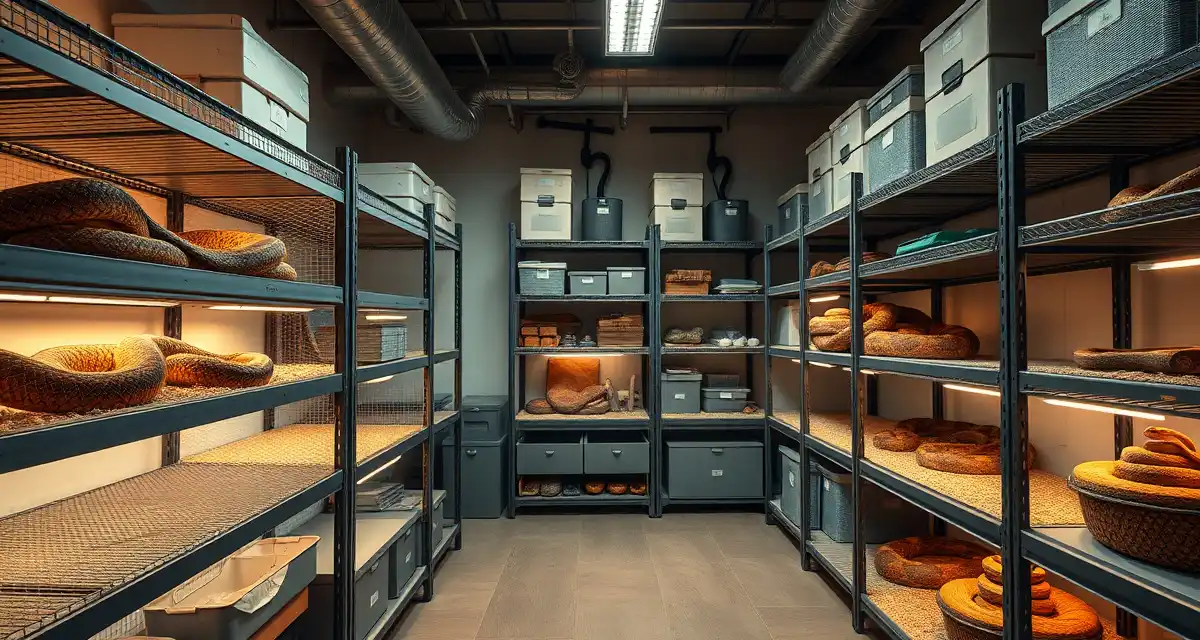
Whether you're setting up a spare room, a basement reptile room, or a purpose-built facility, the decisions you make at the design stage determine how efficiently you can work and how well your animals perform. Retrofitting a poorly planned space is expensive and frustrating.
Room Design and Infrastructure
The first consideration for a boa breeding room is electrical capacity. Multiple large enclosures running radiant heat panels, ceramic heat emitters, or other heating systems add up quickly. Have an electrician assess your available capacity before you fill the room. Circuits should be dedicated to animal areas, not shared with other major appliances.
Ventilation and air circulation matter in any room where humidity is elevated. Stagnant, humid air promotes respiratory pathogens. A combination of passive ventilation (filtered vents) and active circulation (ceiling or wall-mounted fans on low settings) keeps air moving without creating drafts that chill animals. Aim to turn over room air several times per hour without directing airflow directly at enclosures.
Temperature control for the room itself is a separate consideration from individual enclosure heating. Your enclosure thermostats should be doing most of the temperature regulation, but large swings in ambient room temperature make thermostat work much harder. If your facility goes from 65F in winter to 85F in summer, your heating systems will be operating at very different baselines. Climate-controlled spaces (maintaining ambient at 75-80F year-round) reduce variable stress on your equipment and on your animals.
Enclosure Types for Breeding Adults
Adult boa constrictors need properly sized individual enclosures. Front-opening PVC or ABS enclosures are the standard for dedicated breeders -- they allow servicing from the front, which is less stressful for the snake, and provide better insulation than glass tanks. Common adult female enclosure sizes start at 4'x2'x2' for animals under 3 kg and scale up from there.
Avoid housing breeding adults in enclosures that are too small. Chronic space restriction in breeding females causes stress, reduces feeding response, and negatively affects reproductive performance. Gravid females need room to move, position themselves in the thermal gradient, and change positions as gestation progresses.
Clear front panels allow daily visual checks without opening the enclosure. Being able to see your animals' posture, position, and condition in a few seconds during a walk-through helps you catch changes early without disturbing the animals unnecessarily.
Rack Systems for Juveniles and Neonates
While adult breeding animals benefit from individual enclosures, juveniles and neonates can be managed effectively in rack systems. A 6-quart shoebox rack works for neonates through about 150-200 grams. Medium racks (28-quart or 41-quart tubs) are appropriate as animals grow. This tier of housing makes efficient use of space and simplifies temperature management for a large neonate cohort.
When designing your rack section, keep biosecurity in mind. Racks should be easy to clean and should not allow cross-contamination between tubs. Shared heat panels that run the length of a shelf are more efficient than individual UTHs but require that all tubs on a shelf be healthy -- if one animal develops an issue that requires different temperature management, individual units give you more flexibility.
Hides and Enrichment
Every boa enclosure needs at least two hides: one on the warm side and one on the cool side. A humid hide (a container with moist substrate) on the cool side helps with shed cycles. Hides should fit snugly around the animal -- a hide that's too large provides no security benefit. Cork bark rounds, commercial plastic hides, and repurposed food containers all work.
Water dishes should be large enough for the boa to soak in if it chooses to. Snakes often soak before a shed or when they have mites, so a soaking animal can be an early indicator of either event. Check and refresh water every few days and disinfect the dish during substrate changes.
Organizing Your Breeding Room for Efficiency
Design your room layout so that your workflow is efficient. Animals you check most frequently (gravid females, neonates, animals on feeding watch) should be most accessible. Keep male and female enclosures in distinct areas to prevent accidental introductions. Label every enclosure with an animal ID that connects to your records system.
HatchLedger helps you track room organization alongside animal records. If you move an animal to a different enclosure or section, that change gets logged. When you're reviewing a health or breeding issue, knowing exactly where the animal was housed and for how long can be relevant information.
HatchLedger connects your husbandry data to your breeding outcomes so you can evaluate whether specific housing setups are producing better results for your animals.
Frequently Asked Questions
What is the best approach to setting up a boa constrictor breeding housing?
Invest in appropriate electrical infrastructure before you fill the room. Use front-opening PVC or ABS enclosures for adults at the minimum recommended size (4'x2'x2' for females under 3 kg). Run rack systems for neonates and juveniles where space efficiency matters more. Maintain good air circulation without direct drafts, keep ambient room temperature stable, and design the layout so your highest-attention animals are most accessible. Every enclosure should be labeled with an ID that connects to your records.
How do professional breeders handle boa constrictor breeding room setup?
Professional boa breeders design their rooms around their workflows, not just around fitting as many animals as possible. They size enclosures appropriately for breeding adults, even when it means housing fewer animals than a rack-only setup would allow. They invest in proper electrical and HVAC infrastructure because the cost of cutting corners shows up in equipment failures, temperature instability, and health events. They also maintain clear physical organization that connects to their records system, so that every animal's location is documented.
What software helps manage boa constrictor housing and records?
HatchLedger is purpose-built for reptile breeders, connecting animal records, breeding history, clutch outcomes, and financial tracking in one system. Unlike generic spreadsheets, it's designed around the specific workflow of an active breeding season. Free for up to 20 animals.
How do you sex boa constrictor neonates?
Boa constrictor neonates can be sexed by probing or by popping, both of which should be performed by an experienced keeper to avoid injury. Males typically probe to 4-8 subcaudal scales and females probe to 2-3. Recording sex in your records at birth is important for accurate inventory and sales documentation.
How long does it take a boa constrictor to reach breeding weight?
Most B. c. imperator females reach breeding weight (typically 3,000-5,000g depending on locality) at 3-4 years under good feeding conditions. True red-tailed boas (B. c. constrictor) grow larger and may take 4-5 years. Males of most localities are ready to breed at 18-24 months.
Can boa constrictors produce back-to-back litters in consecutive years?
Most experienced breeders rest females for a full season after a large litter to allow proper body condition recovery. A female that drops significant weight during a long gestation needs adequate recovery time before the next breeding cycle. Tracking body weight before and after gestation is the best guide.
Sources
- USARK (United States Association of Reptile Keepers)
- Association of Reptilian and Amphibian Veterinarians (ARAV)
- Herpetologica (Herpetologists League)
- Reptiles Canada Magazine
- World Animal Protection
Get Started with HatchLedger
Boa constrictor breeding involves months of gestation monitoring, pairing records, and litter documentation that is difficult to track reliably across multiple females using notebooks or generic spreadsheets. HatchLedger gives you a single connected system for all of it, from cycling start through neonate sale. Try it free with up to 20 animals.